

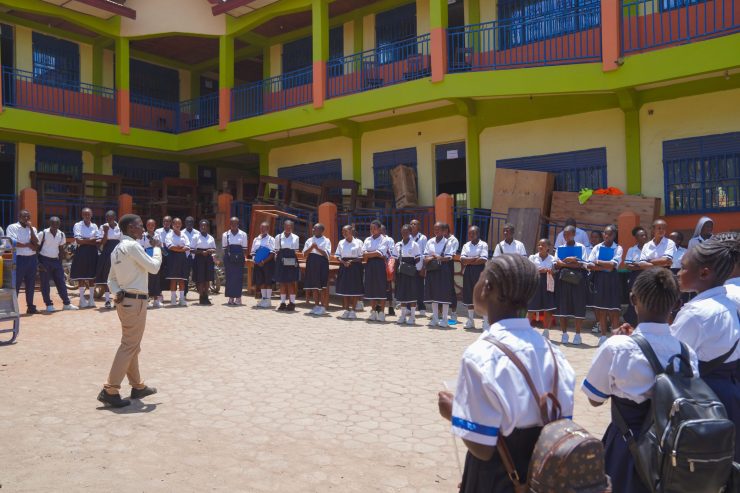
BUNIA, DR Congo, Sept. 2– As schools reopened across the Democratic Republic of the Congo (DRC) for the new academic year, pupils returning to classrooms in the Ebola-hit east found themselves facing a school routine shaped as much by the epidemic as by lessons and textbooks, with handwashing stations, temperature checks and restrictions on close physical contact becoming part of the first days back.
In Bunia, capital of the eastern Ituri Province and the epicenter of the outbreak, pupils in uniform returned to schools across the city on Tuesday, some accompanied by their parents, but several classrooms visited by Xinhua remained only partly filled, reflecting continued hesitation among families over whether it was safe to send children back while Ebola transmission remained active.
In Beni, in neighboring North Kivu Province, the concern was visible in a different way, as pupils washed their hands before entering school, had their temperatures checked and were encouraged to avoid hugs and embraces with classmates after the holiday, while some schools also adjusted seating arrangements to reduce close contact.
The reopening comes as nearly 31 million pupils are expected to attend school across the country this academic year, according to DRC Minister of State for National Education Raissa Malu, who officially launched the new school year Tuesday in the capital Kinshasa against a national backdrop marked by both armed insecurity and serious public health risks.
“Some parts of our country remain confronted with insecurity and conflicts, while others face health risks. But our duty remains the same: to keep schools functioning wherever possible,” Malu said at the opening ceremony. The DRC Ministry of National Education has introduced a three-tier system — green, orange and red — based on the intensity of Ebola transmission.
Some 2,890 schools are considered at high risk, according to authorities. In green and orange zones, in-person classes will continue with corresponding preventive measures. In red zones, where transmission remains active, regular classroom teaching will be temporarily replaced by home-based learning materials and educational programs broadcast on radio and television.
That challenge is particularly acute in eastern DRC, where the Ebola outbreak has crossed the threshold of 3,000 deaths. According to the latest situation report issued Wednesday by the country’s health authorities, 6,186 confirmed cases and 3,007 deaths had been recorded as of Aug. 31, while 1,409 patients had recovered.
The epidemic remains active in six provinces: Ituri, North Kivu, Haut-Uele, Tshopo, South Kivu and Bas-Uele, with Ituri continuing to bear the heaviest burden and accounting for more than four-fifths of confirmed cases recorded nationwide since the outbreak began.
Children have also been heavily affected. According to a report by the United Nations Children’s Fund in August, those aged 17 or younger represent about 21 percent of confirmed Ebola cases but around 33 percent of reported deaths. In Bunia, those concerns had already been voiced before the first day of class, with some parents and members of the teaching community questioning whether sanitary conditions were sufficient to ensure the safety of pupils and teachers.
At Mwanga Beabo primary school, however, Nkwasa Jonathan, a father of two, said he had decided to send his children back, arguing that families had already been living with the epidemic for months and could continue schooling if preventive measures were respected.
“It is true that the epidemic continues to spread in the province, but we are calling on all parents not to give in to fear. We have been living with this situation for months. We continue to protect ourselves by respecting the health measures,” he told Xinhua.
For Jonathan, keeping children at home would risk interrupting their education once again, but other parents in the city remain far less confident about the timing of the reopening. Wawina Rachelle, a pupil’s mother, said she believed schools had reopened too soon while cases were still being reported, drawing a comparison with restrictions imposed during the COVID-19 pandemic.
“I am against this school reopening because the cases continue to increase here. During COVID-19, the children stayed at home, the schools and churches were closed and gatherings were banned. We should have waited this time as well in order to reduce the risk of infection,” she said.
Schools in Bunia have nevertheless introduced a range of preventive measures in an effort to reassure parents and reduce the risk of transmission. At the Pierre Jacques Dufort school complex, pupils are required to wash their hands and have their temperatures checked before entering, while at the Fabia school complex, a room has been prepared to receive possible suspected cases, and at Shalom school, recess has been suspended in order to limit contact among pupils.
Local authorities have so far chosen to follow the national academic calendar, with Bunia Mayor Jean-Bosco Mbuyi Kola saying the authorities did not want the health crisis to derail an already established national school program. “We, as authorities, decided to open the schools because we do not want to compromise an already established national school program.
Despite the persistence of the epidemic, we therefore decided to open the schools on the scheduled date throughout the country,” he said. In Beni, where Ebola transmission is also active, the reopening has brought preventive measures directly into pupils’ daily routines, particularly at the Institut de l’Avenir school complex, where handwashing facilities have been installed, temperatures are checked and seating arrangements have been adjusted to reduce close contact.
Zakindu Musulu Christele, a pupil at the school, said the measures had changed the way students interacted after returning from the holidays, but she considered them necessary given the risks posed by the epidemic. “We think this is a good measure because the epidemic can be transmitted particularly through physical contact, hugs and embraces,” she said.
According to Zakindu, the school has about 15 handwashing stations, roughly one in front of each classroom, with water available to allow pupils to wash their hands regularly during the school day. “I would not want to see a friend fall ill or die because of this epidemic.
I therefore have to protect myself and protect others,” she said. Education authorities in Beni say they are coordinating with health officials to strengthen prevention measures, with Robert Kibonge, head of the Beni educational sub-division, saying officials had been asked to identify the areas most affected by Ebola while some partners had promised to provide additional prevention equipment to schools.
He also stressed the role of teachers in reinforcing awareness among pupils, noting that although many educators already had some knowledge of Ebola dating back to the 2018 outbreak, further sensitization was still needed so that they could pass accurate prevention messages on to children.
“We must strengthen this awareness so that teachers can, in turn, transmit the right information to our children and help them better protect themselves against the disease,” Kibonge said. (Namibia Daily News / Xinhua)

