

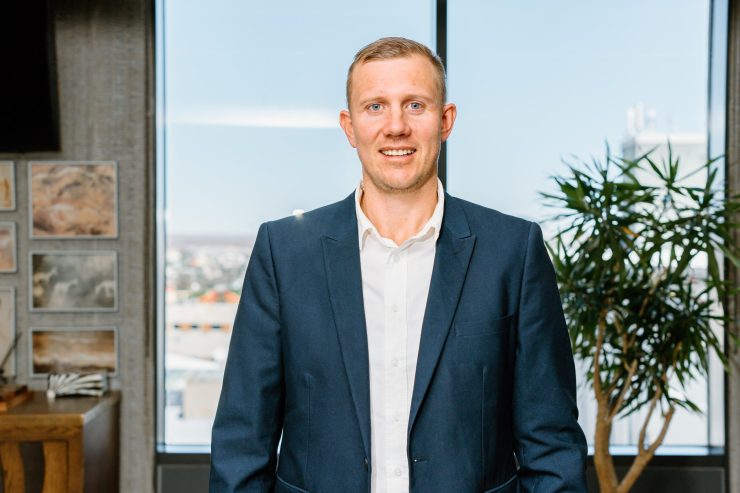
By Awie Thompson, Head of Agriculture, FNB Namibia
Windhoek, Oct.1 ― Agriculture has always demanded resilience. But there are moments when that word carries considerably more weight than usual.
For livestock farmers affected by the current Foot-and-Mouth Disease situation, this is one of those moments. Movement restrictions and uncertainty around market access have very real consequences for farming operations, cash flow and livelihoods. Behind every affected farming business are families, employees and communities whose incomes are connected to agriculture.
Having spent seven years in primary agriculture, farming cattle and crops and working in agro-processing, I understand that these pressures cannot simply be reduced to numbers on a balance sheet. When livestock cannot move or be sold as planned, the consequences can be immediate, even when the underlying farming operation remains sound.

For those directly affected, the priority now is navigating the immediate challenge. The impact will differ from one operation to another, which is why farmers who anticipate cash-flow pressure should engage their financial partners early.
Understanding the individual business, its production cycle and the nature of the disruption is far more useful than assuming one solution will work for everyone. But the current situation also highlights something broader about the environment in which farmers are operating.
Namibian agriculture has had to contend with recurring drought, rising input costs, changing market conditions, price volatility and now renewed biosecurity risks. Farmers cannot predict which challenge will come next, or when.
Increasingly, the competitive advantage will be in how prepared a farming business is to respond when circumstances change.
Resilience is more than surviving a difficult season
We often think about agricultural resilience as the ability to withstand drought or recover after a difficult year. I believe we need to think about it more broadly.
Agricultural businesses operate within cycles that are particularly vulnerable to events beyond their control. Income is often seasonal, production decisions are made months or even years in advance, and the timing of livestock sales can be fundamental to cash flow.

When that cycle is interrupted, as it is for some farmers now, the financial impact can be significant regardless of how well the underlying business has been managed.
That is why periods such as this require understanding rather than assumptions. Every farming operation is different, and the impact of the current restrictions will depend on its location, production cycle, market exposure and individual circumstances.
For financial institutions, this means looking beyond the immediate disruption to understand the business behind it. Where a fundamentally viable farming operation is experiencing temporary pressure because normal trading or livestock movement has been interrupted, the starting point should be an early conversation about those circumstances and what appropriate support may be possible.
That relationship becomes increasingly important as the risks facing agriculture become more complex.
Building resilience together
Agriculture will always involve uncertainty. Farmers understand this better than most.
The current FMD situation is a difficult reminder of just how quickly circumstances can change for reasons outside an individual producer’s control. Right now, the focus must remain on supporting affected farmers and protecting the wider livestock sector.

Over time, resilience will increasingly depend on the strength of the entire agricultural ecosystem: producers, financial institutions, industry bodies, government and the businesses that depend on agriculture.
For farmers, resilience is the ability to keep adapting through changing conditions. For those of us who finance and support agriculture, it means understanding those conditions well enough to stand alongside viable farming businesses when they are tested.
Because the next agricultural advantage will not be the ability to predict every challenge. It will be the strength of the sector’s ability to respond to them together.
Awie Thompson holds a degree in Agricultural Economics from the University of the Free State and brings more than seven years of hands-on experience in primary agriculture, including cattle and crop farming, as well as agro-processing.
He returned to Namibia in 2023 and joined FNB Namibia as an Agricultural Specialist, where he has worked closely with producers across the country, combining practical agricultural experience with financial expertise.
As Head of Agriculture, Thompson is focused on strengthening FNB Namibia’s agricultural offering and supporting the sustainable growth and development of Namibia’s agricultural sector.

