Advertise Here

DBN offers two schemes for Namibian SMEs, KfW and BoN

By Staff Reporter

WINDHOEK, April 24 — The Development Bank of Namibia (DBN) is expanding its offerings with participation in the Bank of Namibia (BoN) SME Economic Recovery Loans scheme. The new loan scheme, in addition to the KfW Bankengruppe (KfW) scheme, brings the number of schemes offered by the DBN to two.

Jerome Mutumba, Head of Marketing and Corporate Communication at DBN, highlighted the differences between the schemes. The BoN scheme has a longer duration of 7 years and an interest rate that floats at prime -0.5%. The KfW scheme has a short duration, with repayment concluding by 31 October 2025, and offers a fixed interest rate of 5.925%, with the first 12 months interest-free.

To qualify for participation, businesses should be clear on the time they require to repay the loan amount. If loans are not repaid within the specified periods, they will be restructured to adhere to DBN’s terms of lending.

Potential borrowers can compare the schemes on the Bank’s webpage, or visit one of its branches in Windhoek, Ongwediva, Rundu, or Walvis Bay. However, the decision to finance applicants is solely at the discretion of the Bank, subject to established standards and requirements in the application form.

The BoN scheme will be available solely to existing DBN borrowers, and each applicant should speak to their individual portfolio manager. The KfW scheme is available to new borrowers with an existing business track record.

Mutumba urged enterprises to assess their need for relief schemes carefully. While these schemes offer support to businesses, they also place additional debt obligations on borrowers. Therefore, it is crucial for borrowers to evaluate the benefit and returns of participation, and use the schemes to recover and grow.

The DBN aims to support larger enterprises and SMEs with a clear development impact. Beneficiaries of the loans must ensure that they further their goals and prolong their sustainability in the medium to long term, Mutumba concluded.

– Namibia Daily News

April 24, 2023 0 comment
0 Facebook Twitter Google + Pinterest
Capricorn Group Supports Community with Sustainable Food Garden Initiative

By Staff Reporter

OKAHANDJA, April 24 — Each year, on April 22, more than 190 countries take action to bring about behavioural change in honour of Earth Day and raise awareness of the climate crisis and the need to protect the earth’s natural resources for future generations. This year, in support of Earth Day, Capricorn Group employees participated in a vegetable gardening project in a small community in Okahandja as part of Christ’s Hope Namibia’s mass food gardening project.

More than 40 employees participated in the outreach event, which took place on April 21, 2023, in Okahandja. The Changemakers spent the day preparing the land, planting seeds, painting tires, and more, and managed to plant spinach, cabbage, and onions that will support the centre’s feeding scheme for over 90 children. This initiative was part of Capricorn’s sustainability drive and ongoing commitment to giving back and supporting the communities in which it operates.

Marlize Horn, the Group Executive of Brand & Corporate Affairs and Executive Officer of Capricorn Foundation reiterated Capricorn’s commitment to giving back to communities not just in cash but also in kindness. The vegetable garden is an important method of securing a sustainable supply of nutritious food for vulnerable communities, and Capricorn is proud to be able to support the creation of this for Christ’s Hope.

Christ’s Hope International Namibia has a 17-year track record of caring for orphaned and vulnerable children. It provides sustainable support at ten care points located in Keetmanshoop, Rehoboth, Okahandja, and Oshikuku to free children from the cycle of AIDS and poverty. The Okahandja community garden will be supported by the Christ’s Hope team and centre staff, and nearby families with no income have also been identified to join to support the garden and benefit from the produce.

“The Capricorn Foundation is one of our sponsors for the centres throughout the country. Their commitment to come and assist us to develop this garden is more than we could have asked for. We are truly grateful for the support that we are receiving. The input of the Changemakers can ensure a lasting and sustainable impact on them, their surrounding communities, as well as our natural environment,” said Hannelie Turner, Christ’s Hope International Namibia’s Country Team Leader.

In summary, Capricorn Group employees took part in a vegetable gardening project in Okahandja to celebrate Earth Day and support Christ’s Hope Namibia’s mass food gardening project. This initiative is part of Capricorn’s sustainability drive and ongoing commitment to giving back to the communities in which it operates. The vegetable garden will help support vulnerable communities and ensure a sustainable supply of nutritious food for orphaned and vulnerable children.

Namibia Daily News

April 24, 2023 0 comment
0 Facebook Twitter Google + Pinterest
Retirement benefits in Namibia – an analysis of Pillar 2

By Staff Reporter

WINDHOEK, April 24 — Retirement benefits are an essential aspect of any country’s social welfare scheme, with different nations using various models of pension provision. In Namibia, the government has adopted the World Bank model for pension provision, which consists of three pillars. In this article, we will consider Pillar 2, which deals with occupational retirement funds.

Occupational retirement funds have been part of the Namibian financial sector for over 50 years. Although it is not mandatory, many Namibian companies sponsor or participate in a retirement fund on behalf of their employees, as retirement benefits are often an important part of the package offered to staff. In comparison to other African countries, such as Ghana, Zambia, and Nigeria, which have started pursuing the compulsory establishment of occupational pension schemes to enhance retirement savings benefits accrued under other pillars, Namibia does not have such requirements.

The Namibian government has sought to encourage the provision of retirement benefits by offering tax incentives to employers and employees. These incentives include tax deductibility of employer and employee contributions to retirement funds, no tax levied on returns earned by retirement funds, and only two-thirds of the benefit payable on retirement being taxed. If quantified, the value of these tax incentives would be significant.

Namibian retirement funds are currently regulated by the Pension Funds Act, Act No. 24 of 1956 (the PFA), inherited from South Africa, and no amendments have been made to the PFA since Namibia’s independence in 1990. However, the PFA will be replaced by the Financial Institutions and Market Act, Act No. 2 of 2021 (FIMA), allowing for key amendments to recognize retirement fund industry developments over the past 33 years, moving from a rule-based to a risk-based regulatory environment, and providing the Namibian Financial Institutions and Markets Authority (NAMFISA) with more supervisory and regulatory powers. The Income Tax Act, Act No 24 of 1981 (the ITA) outlines how retirement fund contributions, returns, and benefits are to be taxed.

Based on information sourced from NAMFISA, the number of Namibian retirement fund members was 238,603 as of Q3 2022. Of these, 94,291 were members of the Government Institutions Pension Fund (GIPF). This number is higher than expected considering the country’s high unemployment rate, large informal sector, and the fact that occupational pension schemes are not mandatory in Namibia. However, the effectiveness of the Pillar 2 retirement provision in Namibia is curtailed mainly due to the lack of compulsory preservation.

Namibia is one of the few countries in the world that does not have compulsory preservation rules for retirement savings. This has supported the practice of members withdrawing benefits when changing jobs. Approximately a year ago, a draft FIMA regulation stipulated the requirement to preserve at least 75% of retirement savings when leaving a retirement fund. The legislation reflects the government’s intention to reduce the likelihood of retirement fund members being impoverished after retirement. The draft mandatory preservation legislation has met with opposition from many Namibians, who believe that it takes away their right to choose how to utilize their retirement benefits.

One of the concerns raised by critics of the proposed compulsory preservation regulation is that there is currently no social security net to support Namibians who lose their jobs. These employees depend on being able to access their retirement savings to support themselves and their families while they are unemployed.

Several countries have allowed members to have early access to their retirement fund savings to alleviate financial hardship arising from the Covid pandemic. Malaysia, Uganda, and Zambia introduced similar interventions in 2022, while Eswatini allowed emergency access to occupational retirement fund savings in 2020.

In conclusion, while Namibia’s Pillar 2 retirement provision has been around for over 50 years and has been well-regulated, the lack of compulsory preservation rules for retirement savings is a significant hindrance to its effectiveness. Despite opposition from some Namibians, the introduction of mandatory preservation legislation is necessary to improve the retirement outcomes of Namibians. However, it is important to strike a balance between accessibility and preservation requirements to cater to those who may face financial hardship in times of crisis. Minimum contributions towards retirement savings may also be worth considering in the future, as they can help ensure that Namibians save enough to achieve a reasonable level of post-retirement income. Ultimately, the goal is to create a retirement system that is sustainable and equitable for all Namibians. – Namibia Daily News

April 24, 2023 0 comment
0 Facebook Twitter Google + Pinterest
Hong Kong women’s cricket team to participate in quadrangular tournament in Namibia

By Benjamin Wickham

Hong Kong, April 24 — Former Australian fast bowler Geoff Lawson has taken temporary charge of the Hong Kong women’s team for a quadrangular tournament in Namibia this week. The women’s team will play their first international cricket matches in Africa in the tournament. Lawson, who was also the former coach of Pakistan, expressed his honour to work with the Hong Kong women’s team. Hong Kong will play against Namibia in their first match on Monday. This will be followed by matches against Uganda and the United Arab Emirates. Each side will play the other twice before the final and third-place game on May 2.

The Hong Kong team is led by Kary Chan, who will be supported by the newly appointed vice-captain Natasha Miles. Many of the players were involved in the FairBreak Invitational, which took place earlier this month. Chan said that competing against strong opposition in a different part of the world is an exciting prospect for the team. She added that her team is passionate about playing cricket and aims to put together winning performances in major tournaments.

Lawson, who is familiar with many of the players, will oversee the team in his role as interim head coach. He had previously coached a select XI during a tour of Europe and was a central figure with FairBreak in Hong Kong. He said while the objective is always to win, he would also be “looking at the bigger picture” and supporting individuals and the team to keep developing and improving as they build towards some big tournaments later in the year.

Cricket Hong Kong’s general manager, Mark Farmer, said that the tournament would provide a fantastic platform for the players to perform and gain invaluable experience. Most of the cricket games played by the team are in the Asian region, so the opportunity to play against opposition they have not had the chance to compete against previously, such as Namibia, is exciting.

The Hong Kong squad for the tournament includes Kary Chan (captain), Alison Siu, Betty Chan, Elysa Hubbard, Iqra Sahar, Lemon Cheung, Mariko Hill, Marina Lamplough, Maryam Bibi, Natasha Miles (vice-captain), Pull To, Ruchitha Venkatesh, Shanzeen Shazhad, and Yasmin Daswani. – Namibia Daily News

April 24, 2023 0 comment
0 Facebook Twitter Google + Pinterest
Cult leader arrested in Kenya after police discover 47 bodies in shallow graves

By Staff Reporter

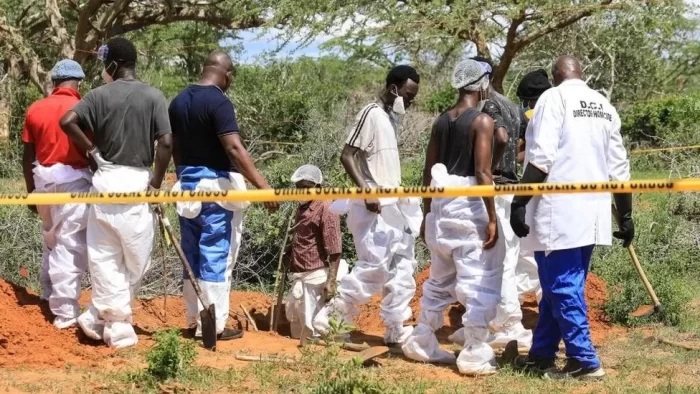
MALINDI, April 24 – Kenyan police have exhumed 47 bodies near the coastal town of Malindi, as they investigate a preacher who allegedly told followers to starve themselves to death. The disturbing discovery of shallow graves in the Shakahola forest, where 15 members of the Good News International Church were rescued last week, has shocked the nation. Children’s bodies were among the dead.

Church leader, Paul Makenzie Nthenge, is in custody pending a court appearance and has been described as a “cult leader” by state broadcaster KBC. So far, 58 graves have been identified, and one is believed to contain the bodies of five members of the same family.

Mr Nthenge has denied wrongdoing but has been refused bail. He claims to have shut down his church in 2019, but the police believe that he is still active and has continued to lure people into his cult. He allegedly named three villages – Nazareth, Bethlehem, and Judea – and baptized followers in ponds before telling them to fast.

Victor Kaudo of the Malindi Social Justice Centre said, “When we are in this forest and come to an area where we see a big and tall cross, we know that means more than five people are buried there.”

Kenyan Interior Minister, Kithure Kindiki, has declared the entire 800-acre forest a crime scene and sealed it off. Pathologists will take DNA samples and conduct tests to determine whether the victims died of starvation.

Kenya is a religious country, and there have been previous cases of people being lured into dangerous, unregulated churches or cults. The government has a responsibility to crack down on such groups and ensure the safety of its citizens. The tragedy of the Malindi cult is a stark reminder of the dangers of blind faith and the importance of protecting vulnerable individuals from exploitation.

Source: BBC News

April 24, 2023 0 comment
0 Facebook Twitter Google + Pinterest
Namibia and Finland Strengthen Ties Through State Visit

By Staff Reporter

WINDHOEK, April 24 — President Sauli Niinistö of the Republic of Finland is set to undertake a State Visit to the Republic of Namibia on Thursday, 27 April 2023, and Friday, 28 April 2023, in Windhoek, as announced in a press release. The visit is aimed at discussing the global political situation, global challenges, and bilateral relations between Namibia and Finland.

The history between Namibia and Finland goes back over 150 years, and the two countries are committed to strengthening their partnership and relations further. Finland has been a major international partner of Namibia in various global issues such as peacebuilding and mediation, gender and human rights advances, and renewable energy challenges.

During the State Visit, President Niinistö will engage with President Hage G. Geingob in Official Talks to discuss various aspects of their bilateral cooperation and the Africa Strategy of Finland. President Niinistö will also meet with the Namibian Prime Minister and the Speaker of the National Assembly of Namibia to discuss the business potential between the two countries.

As part of Finland’s engagement with Africa and its strategic goal of growing connections with the continent, Finland has funded various programmes on sustainable water management within the context of SADC cooperation. Moreover, Finland is among Namibia’s top 20 trading partners. Namibia’s overall exports to the Finnish market totalled N$1.8 billion, down from the N$785.0 million recorded in 2021. On the other hand, Namibia’s imports from Finland increased to N$1.1 billion in 2022 from N$388.6 million recorded the previous year (2021).

Furthermore, the visit will be accompanied by a business delegation with representatives from various business sectors in Finland. President Niinistö will participate in a business seminar to be held at Hilton Hotel in Windhoek under the themes: Accelerating implementation of the 4th Industrial Revolution by leveraging partnerships and innovation to promote the Green Transition for job creation and eradication of poverty and Advancing Policy Reforms to enhance integrated solutions for sustainable and inclusive growth in Namibia.

The purpose of this seminar is to discuss how Namibia and Finland can work together to leverage smart, secure and sustainable solutions to promote a green transition and the 4th Industrial Revolution, as well as to enhance bilateral trade between Namibia and Finland. The specific outcomes envisaged are: strengthening business partnerships between the two countries to promote trade and investment in key sectors, identifying sectors that hold the most potential to create jobs and stimulate economic growth in Namibia, and generating export potential for Namibian-Finnish goods and services into Finland.

In addition to the official talks, President Niinistö will lay a wreath in honour of Namibia’s heroes and heroines at the Heroes’ Acre in Windhoek. The last State Visit from the Republic of Finland to the Republic of Namibia was made 12 years ago by former President Tarja Halonen in 2011.

In conclusion, the State Visit of President Sauli Niinistö of the Republic of Finland to the Republic of Namibia is a significant step towards strengthening the partnership and relations between the two countries. The visit is expected to bring about a renewed focus on enhancing bilateral trade and investment in key sectors and identifying solutions for sustainable and inclusive growth in Namibia.  – Namibia Daily News

April 24, 2023 0 comment
0 Facebook Twitter Google + Pinterest
Namibian writers strive to promote indigenous culture, languages

WINDHOEK, April 24 — To arouse readers’ interest in indigenous language books in Namibia is a pursuit for local author Wilbard Lazarus.

“Our stories and experiences are unique and deserve to be shared with the world,” Lazarus told Xinhua on Sunday as the world observes World Book and Copyright Day under the theme of “Indigenous Languages.”

His book “Luhwango lwaAmatoye”, which was published in 2022, explored traditional beliefs, myths, history, and cultural practices.

Lazarus wrote the book in a local language, spoken by about 48 percent of households in Namibia, to inspire confidence in linguistic diversity and national pride, against the backdrop of the shortage of published literature in local languages.

“Our languages and cultural practices are a significant part of our identity, and thus strive to keep them alive,” he said, adding that his aim is to create a deeper understanding of local culture and promote cultural preservation.

Lazarus wrote the book in 2017 after completing secondary school, and it got published last May due to a lack of funds. “Another challenge is finding publishers willing to take on my work. Marketing and distribution can be difficult, especially for indigenous language books,” he said.

“I want to write more books to promote cultural preservation. I also hope to mentor and support other local authors passionate about writing,” said Lazarus, noting that he wants to groom talent and spur reading habits in Namibia.

Writing has been a spiritual journey for Lazarus. “Writing and publishing a book has been a fulfilling experience for me, and it has also allowed me to connect with other like-minded individuals passionate about preserving culture,” he said.

Lazarus is one of the Namibian authors to promote local literature in the southern African nation.

Otto Kapuka has written three English books since 2017 centred on personal development to motivate locals to reach their full potential.

“I’m busy with my 4th English book, which I envision publishing this year,” said Kapuka, who also has the idea to have all his four books translated into indigenous languages. (Xinhua)

April 24, 2023 0 comment
0 Facebook Twitter Google + Pinterest
Pine Pienaar to assist Namibia with defence in the 2023 Rugby World Cup

NDN Staffer

WINDHOEK, April 24 — Namibia’s rugby team, the Welwitschias, are gearing up for the Rugby World Cup 2023, and former Springbok coach Allister Coetzee has called in some South African expertise to help them prepare. One of the assistant coaches at the Vodacom Bulls, Pine Pienaar, has been enlisted to help with Namibia’s defensive systems. Pienaar’s contract with the Bulls will not be renewed after the current season, and he is relishing the opportunity to work with Coetzee and the Welwitschias in the run-up to the World Cup.

Coetzee’s Namibia is in Pool A, where they will face off against tournament hosts France, two-time winners New Zealand, Italy and Uruguay. This is a challenging group, and the Welwitschias will need to be at their very best to advance to the knockout stages of the competition.

Pienaar’s experience with the Vodacom Bulls will be invaluable as Namibia looks to tighten up its defence ahead of the tournament. The Bulls are one of South Africa’s most successful rugby teams, having won the Super Rugby competition three times. Pienaar has been with the team since 2018 and has been instrumental in developing their defensive systems.

Speaking to the South African newspaper Rapport, Pienaar said he was thrilled to be joining the Namibia coaching staff. “To be able to go to the World Cup is a dream for any player or coach,” he said. “I am incredibly looking forward to it.”

Coetzee, who coached the Springboks between 2016 and 2018, will be hoping that Pienaar’s expertise can help Namibia pull off some upsets in Pool A. The Welwitschias have never made it past the pool stage of the World Cup, but with the help of Pienaar and Coetzee, they will be hoping to cause a few surprises in France in 2023.

The Rugby World Cup is the biggest stage in rugby union, and Namibia will be hoping to make their mark on the tournament this year. With the help of Pienaar and Coetzee, the Welwitschias will be looking to upset the odds and make history at the 2023 Rugby World Cup. – Namibia Daily News

April 24, 2023 0 comment
0 Facebook Twitter Google + Pinterest
Namibia’s Oil Discoveries Offer Opportunities for Collaboration with South Africa

NDN Staffer

PRETORIA, April 24 — Namibia’s recent oil discoveries in the Orange Basin offshore southern Namibia have presented an opportunity for collaboration between the country and South Africa in the oil and gas sectors. The Namibian President, Hage Geingob, has urged his South African counterpart, Cyril Ramaphosa, to take advantage of these discoveries for mutual benefit. Namibia has made three oil discoveries in the area over the past year, presenting the potential for growth and prosperity after a period of economic difficulty.

Geingob has previously stated that the estimated 6.5 billion barrels of oil production could earn Namibia between N$60 billion and N$95 billion annually in taxes and royalties. The oil projects are expected to generate over 3,600 jobs at the peak of production and double Namibia’s gross domestic product by 2040 to about N$636 billion.

During his state visit to South Africa, Geingob and Ramaphosa agreed to have their agreements audited before the binational commission later this year. Namibia and South Africa have over 100 bilateral agreements that cover various sectors, but the two presidents have been accused of using these agreements for their personal gain.

Ramaphosa has also announced that Namibia and South Africa will host a business forum in Windhoek during their bilateral meeting. The forum will be attended by business people from both countries, and the ministers responsible for trade and industry will convene it. One of the areas of cooperation will be infrastructure in the water sector.

Furthermore, Namibia and South Africa have signed an agreement to focus on tourism. The signing was witnessed by the two countries’ ministers, Pohamba Shifeta and Patricia de Lille. This marks another area key to the economic development aspirations of both countries.

In conclusion, Namibia’s oil discoveries present an opportunity for collaboration between Namibia and South Africa in the oil and gas sectors. This opportunity could bring growth and prosperity to Namibia, and the two countries could benefit from joint business forums and agreements. The focus on tourism and infrastructure in the water sector is an indication of the potential for growth and development in various sectors between the two countries. – Namibia Daily News

April 24, 2023 0 comment
0 Facebook Twitter Google + Pinterest
Reintroduced cheetahs may occupy entire national park, warn scientists from Namibia

NDN Staffer

WINDHOEK, April 22 — Namibian top scientists have raised concerns that the re-introduction of cheetahs to India was planned without considering their spatial ecology, which may lead to conflicts with local people. The scientists, from the Cheetah Research Project of Leibniz-IZW in Namibia, warned that more felines may venture out soon as the size of their habitat is small compared to the space needed for the free movement of the predators. They noted that Kuno National Park, where the cheetahs have been released, is an unfenced wilderness area spread over an area of 750 square kilometres, and it is likely that the released animals will move far beyond the park’s boundaries and cause conflicts with neighbouring villages.

The re-introduction of cheetahs to India comes 70 years after their extinction in the country. A total of 20 cheetahs from Namibia and South Africa have been introduced to Kuno National Park since last year to establish a free-ranging population. However, the scientists in their letter published in the journal Conservation Science and Practice criticized the re-introduction plan, stating that it was done without considering the spatial ecology of the cheetahs.

Spatial ecology addresses the fundamental effects of space on the movement of individual species and on the stability of multispecies communities. The scientists pointed out that in southern Africa, cheetahs live in a stable socio-spatial system with widespread territories and densities of less than one individual per 100 square kilometres. The plan for cheetahs in Kuno National Park assumes that the high prey density will sustain high cheetah densities, even though there is no evidence for that, they said.

The carrying capacity for cheetahs under natural conditions is usually between 0.2 and 1 adult per 100 square kilometres. Based on their research results from a long-term study of the spatial behaviour of cheetahs in Namibia, as well as comparable work in East Africa, scientists have warned against overestimating the carrying capacity of the area.

Male cheetahs follow two different spatial tactics. Territory holders occupy territories consisting of a collection of important communication hotspots, while males without territories (”floaters”) move and live between existing territories, as do females, with occasional forays into territories to access important information at marking sites. The territories do not border each other, and their centres are always about 20 to 23 kilometres apart.

The scientists predicted that the reintroduced cheetahs will most likely be found far outside the national park and could come into conflict with farmers in the vicinity of the park. The researchers added that the deeply rooted behaviour of the felines will lead to a system in India with territories about 20 to 23 kilometres apart. “This distance is independent of the actual size of the territories or the prey base,” said Bettina Wachter from the Cheetah Research Project.

In conclusion, the re-introduction of cheetahs to India should be done in a well-thought-out and planned manner, considering the spatial ecology of the felines. This will ensure that the animals can coexist peacefully with the local people and avoid conflicts. It is crucial to balance the conservation of endangered species with the needs of the local communities to promote sustainable development. – Namibia Daily News

April 22, 2023 0 comment
0 Facebook Twitter Google + Pinterest