

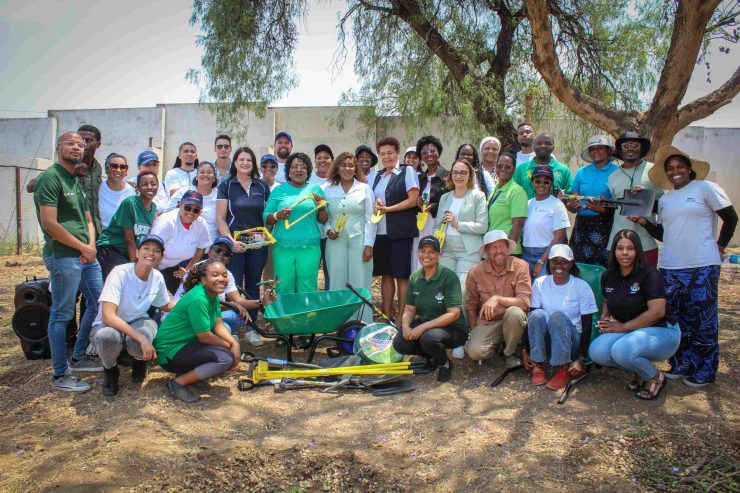
WINDHOEK, Oct.13 — In commemoration of World Mental Health Day, Capricorn Group ChangeMakers, in partnership with the Ministry of Health and Social Services, the Ministries of Environment, Forestry and Tourism and Agriculture, as well as the Office of the Prime Minister, launched the “Garden of Hope” at the Windhoek Central Mental Health Hospital on Friday, 10 October.
This initiative is a significant step in combining mental health awareness with environmental stewardship, creating a space of healing, hope, and renewal for patients and the broader community.
The idea for the Garden of Hope was born during a recent courtesy visit by Capricorn Group and the Capricorn Foundation to the Windhoek Mental Health Centre, following a request from the Office of the Prime Minister to the Foundation to explore possible support to the Centre.
The Centre’s management shared their ambition to transform an open space at the Centre into a productive fruit and vegetable garden, supporting patient rehabilitation and providing fresh produce for patients.
On 10 October, World Mental Health Day, Capricorn Group’s ChangeMaker outreach brought together Capricorn employees, government ministries, and donors to turn this vision into reality.
The event featured a range of activities designed to enhance the community’s green spaces. The participants planted fruit trees, built therapeutic garden beds, and set up irrigation systems and other essential infrastructure.
They also created sensory gardens and meditation areas for a tranquil environment, and efforts were made to build raised beds and install necessary garden equipment.
The Capricorn Group brought on board expert permaculture consultant Stephan Eins to assess the land and advise on the garden’s layout and plant selection, ensuring the space would flourish and serve its intended purpose.
The Ministry of Environment, Forestry and Tourism took Capricorn Group by the hand as co-sponsors of the event, generously contributing a range of plants and seedlings from their nursery, including the official Tree of the Year, in celebration of Arbour Day the following day.
The Ministry’s team not only provided these resources but also actively participated in the planting activities, offering their technical expertise and guidance throughout.
In the handover event, the keynote speaker was Dr H.M. Ndjaba. Dr Njaba noted that exercise is a method recommended for mental well-being, and therefore, patients will be encouraged to tend to the garden.
She also noted the power of collaboration and that this Garden of Hope is a testament to changing the future by collaborating through shared partnership.
The highlight was the handover of the Garden of Hope by Marlize Horn, Chief Brand and Corporate Affairs of the Capricorn Group.
Marlize emphasised the significance and vision of the Garden of Hope. She highlighted how gardening can be therapeutic and have a profound impact on mental health.
This initiative offers patients a nurturing environment where healing can flourish in both body and mind.
She said, “For the Capricorn Group, the Garden of Hope is not just a space for plants to grow, but a symbol of renewal, resilience, and community.
Together with our partners, we are not only cultivating fresh produce but also a sense of belonging and purpose for everyone involved.
This initiative reminds us that healing happens in many forms, and that together, we can nurture hope where it is needed most.”
What further provides comfort is the active role and responsibility that the Mental Health Officers are taking in ensuring the success of the garden through the implementation of the ward gardening rotation schedule.
In his concluding remarks, Dr B.P Bock said “Sometimes we overlook the importance of stakeholder engagement when it comes to supporting Government and its initiatives and efforts. We cannot solve our problems without the help and support of our stakeholders.
Therefore, I would like to thank the Capricorn Group Changemakers for their support in establishing the Garden of Hope for our patients”.
The Garden of Hope demonstrates how collaboration can lead to positive change. As patients start to garden, it will provide food and play an essential role in their recovery.

