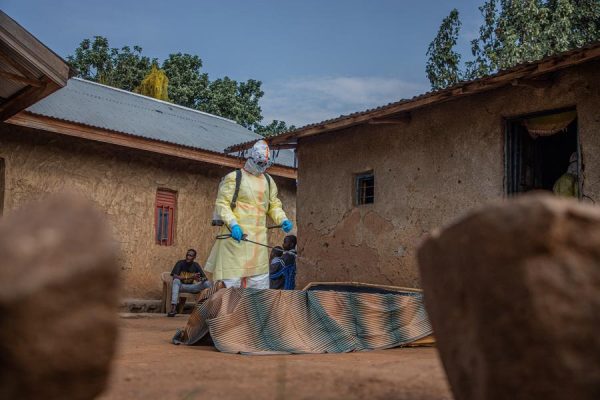
KINSHASA, Aug. 7 — Confirmed Ebola cases in the Democratic Republic of the Congo (DRC) have reached 4,053, including 1,850 deaths, as health authorities investigate whether changes in the virus may be contributing to the unprecedented outbreak and accelerate trials for potential vaccines and treatments.
The outbreak, caused by the Bundibugyo ebolavirus, has become the second-largest Ebola outbreak ever recorded globally and the largest in the DRC since the virus was first identified in the country in 1976.
OUTBREAK CONTINUES TO OUTPACE RESPONSE
The latest figures released by the DRC authorities showed that as of Wednesday, the country had recorded 4,053 confirmed cases, including 1,850 deaths and 793 recoveries. Cases had been reported in 53 health zones across the provinces of Ituri, North Kivu, South Kivu, Haut-Uele and Tshopo.
Ituri, the epicenter of the outbreak, accounts for 86.9 percent of confirmed cases.
Jean Kaseya, director-general of the Africa Centers for Disease Control and Prevention (Africa CDC), said Thursday at an online briefing that the reported figure and deaths could be underreported.
He said studies would be initiated to determine whether additional factors were contributing to the severity and rapid growth of the outbreak, including whether the virus had undergone mutations.
According to Kaseya, the main weakness in the response was not a lack of funding, but a gap in sufficiently mobilizing affected communities. He called for a shift toward a more community-led response, including earlier case detection, stronger contact follow-up, easier access to testing and care, timely support for frontline workers, and closer engagement with religious, traditional, women and youth leaders.
“Community ownership must be at the heart of the response,” said World Health Organization (WHO) Director-General Tedros Adhanom Ghebreyesus on Thursday on social media, after visiting the DRC’s capital Kinshasa.
VACCINE, TREATMENT STRATEGIES BROADENED
There is currently no licensed vaccine or approved specific treatment for the disease caused by the Bundibugyo ebolavirus. Kaseya said officials had decided to expand the use of Ervebo, a vaccine developed and licensed against the Zaire ebolavirus species, among populations in Ituri and North Kivu while formal studies continued.
He said field observations suggested that people previously vaccinated against Zaire ebolavirus who later contracted Bundibugyo virus disease had either developed milder symptoms or survived. No deaths had been observed in the previously vaccinated group, he said, while deaths in the current outbreak had occurred among unvaccinated patients.
Vasee Moorthy, acting lead of the WHO R&D Blueprint, said Tuesday at a press conference in Geneva that the agency was also reviewing new animal-study data on possible cross-protection offered by Ervebo.
Progress has also been reported on candidate vaccines specifically designed to target Bundibugyo virus. A vaccine developed by the University of Oxford and the Serum Institute of India entered Phase 1 clinical trial in Britain on July 24, while a second candidate vaccine developed by Moderna was expected to begin Phase 1 testing in Canada this week, said Moorthy.
WHO has emphasized that vaccination is only one component of a comprehensive Ebola response. Surveillance, laboratory testing, case management, infection prevention and control, safe and dignified burials, and community engagement remain essential to containing the outbreak. (Namibia Daily News / Xinhua)