Advertise Here

Namibia set for full nationwide TV, radio coverage

WINDHOEK, July 10 — Namibia is set to achieve full nationwide radio and television coverage following the signing of a 121-million-Namibian-dollar (about 6.82 million U.S. dollars) contract for Direct-To-Home (DTH) transmission services Thursday.

The agreement, facilitated by the Central Procurement Board of Namibia with international satellite company Intelsat Ventures on behalf of the Namibian Broadcasting Corporation (NBC), aims to bridge the information gap across the southern African nation.

NBC Director General Stanley Similo described the occasion as “a very profound day in the history of NBC and, by extension, Namibia.” He emphasized that the DTH project aims to increase national coverage from the current 74.5 percent for television and 78 percent for radio to 100 percent.

“What DTH does is that it gives immediate, direct coverage to the entire country. This is a significant milestone that Namibia is witnessing today,” he said.

Similo added that within six to seven months, Namibians across the country will have improved access to national radio and television services. (Xinhua)

July 11, 2025 0 comment
0 Facebook Twitter Google + Pinterest
UNEP warns of climate change risks to older persons, ecosystems

NAIROBI, July 10  — Extreme weather events linked to global warming have exposed older persons and fragile ecosystems to significant risks, the United Nations Environment Program (UNEP) warned in a new report released Thursday in Nairobi, the Kenyan capital.

In its seventh edition, the UNEP’s Frontiers Report said that rising global temperatures present an existential threat to the survival of older adults.

According to the report, climate change is likely to escalate the melting of icecaps, resulting in widespread release of disease-causing pathogens such as bacteria, fungi, and viruses.

The 2025 edition also highlighted the reemergence of banned chemicals and persistent organic pollutants in the environment and food chain due to flooding.

In addition, the report sounded an alarm over the risk of ageing dams to downstream fishing communities and pristine landscapes, adding that the removal of obsolete and unsafe water reservoirs has intensified in Europe and North America.

UNEP Executive Director Inger Andersen said the Frontiers Report endeavors to delve into and spotlight emerging planetary threats, and propose some policy interventions required to turn the tide.

“All these emerging issues require careful attention and proactive action. I call on policymakers to read this issue of the biennial Frontiers Report and take forward its findings to protect people, nature and economies from threats that will only grow with each passing year,” Andersen added. (Xinhua)

July 10, 2025 0 comment
0 Facebook Twitter Google + Pinterest
Study finds people prefer human over AI in emotional talk

JERUSALEM, July 10 — Israeli and U.S. researchers have found that people value empathetic responses more when they believe they came from a human, even when the responses were written by artificial intelligence (AI), the Hebrew University of Jerusalem said in a statement on Thursday.

Large language models show strong emotional and social skills, which could improve how people interact with AI and how AI provides emotional support.

However, it is unclear whether people feel the same level of empathy from AI as they do from humans. The new study, published in Nature Human Behaviour, included over 6,200 participants across nine experiments.

In each case, people received a supportive message written by an AI model. Half were told the message was from a human, while the rest were told it was from an AI chatbot.

People who believed the message came from a human rated it as more caring and supportive. They also reported more positive emotions and fewer negative ones. If they thought AI helped write a human message, they rated it lower.

People also consistently chose human responses when seeking emotional support. The researchers warned that overreliance on AI might make words feel less sincere and weaken emotional connections.

While AI responses were often still emotional, they lacked the human touch. The study advances understanding of empathy, especially in human-AI interactions, and helps show which types of human connection should be preserved and which might be replaced by AI.

It suggests that if AI replaces too much emotional interaction, it could hurt real relationships and increase loneliness. They concluded that in fields like education, the key is knowing where human presence still matters most. (Xinhua)

July 10, 2025 0 comment
0 Facebook Twitter Google + Pinterest
Namibia signs pact to align small businesses with int’l trade standards

WINDHOEK, July 10  — Namibia has formalized a strategic partnership between its investment board and national standards body to enhance product compliance and facilitate local enterprises’ access to regional and international markets.

The Namibia Investment Promotion and Development Board (NIPDB) and the Namibian Standards Institution (NSI) signed a memorandum of understanding (MoU) on Wednesday in the national capital of Windhoek to strengthen the country’s quality infrastructure and support the growth of micro, small, and medium enterprises (MSMEs).

Speaking at the signing ceremony, Nangula Uaandja, chief executive officer of the NIPDB, said the agreement is a key step in creating a standards-based economic environment that supports business competitiveness and investor confidence.

“At the NIPDB, we recognize that a credible standards infrastructure is essential — whether for a small business entering regional value chains or for an investor evaluating Namibian industries,” Uaandja said.

According to Uaandja, under the new agreement, the NIPDB and NSI plan to expand outreach to MSMEs across Namibia, raising awareness about certification processes, labeling, and packaging standards.

They also aim to support local industries in aligning with regional and global standards, especially under the African Continental Free Trade Area, she added.

Additional plans include continued joint participation in technical committees and the integration of standards guidance into the NIPDB’s business support services.

“This partnership is about unlocking Namibia‘s competitiveness,” Uaandja said. “By combining investment promotion with technical support on standards, we are laying the groundwork for businesses to thrive in a rules-based trade environment.”

Namibia‘s MSME sector contributes about 12 percent to the country’s gross domestic product and employs up to 420,000 people across formal and informal sectors. (Xinhua)

July 10, 2025 0 comment
0 Facebook Twitter Google + Pinterest
NAMCOR Corruption Scandal: Court Appearance of Accused Individuals

By John K WaDisho

WINDHOEK, July 10 — The Windhoek Magistrate’s Court saw the brief appearance of eight individuals implicated in the NAMCOR corruption scandal, alongside five corporate entities. The group faces several charges under the Prevention of Organised Crime Act (POCA) and the Anti-Corruption Act, following serious allegations regarding malfeasance that amounts to over N$480 million.

During the court proceedings, the state requested a postponement until 14:15 to allow for a detailed explanation of the charges to the accused. In a significant move, the state also objected to bail for all individuals involved. Prosecutors expressed concerns that the accused might interfere with ongoing police investigations or potentially abscond.

Among those charged are former NAMCOR Managing Director Immanuel Mulunga, alongside Cornelius Willemse, Jennifer Hamukwaya, Olivia Dunaiski, Peter Hango Elindi, Malakia Elindi, Lydia Elindi, and Panduleni Hamukwaya. Additionally, several corporate entities are linked to the case, including Enercon Namibia (Pty) Ltd, Onyeka Clearing and Forwarding CC, Nyambali Medical Centre CC, Panduleni Farming CC, and Parkwood Petroleum Logistics CC.

Legal representation for some of the accused is being provided by attorneys Sisa Namandje and Milton Engelbrecht. The authorities have stated that five further arrests related to this case are pending- Namibia Daily News.

July 10, 2025 0 comment
0 Facebook Twitter Google + Pinterest
Russian strike on Kiev leaves 2 dead, 16 injured

KIEV, July 10  — Russia’s overnight strike on Kiev on Thursday killed at least two people and injured 16 others, local authorities said. The victims, a 68-year-old Kiev resident and a 22-year-old metro police officer, were killed in the central Podilskyi district, the Ukrainian Interior Ministry said. The attack damaged eight of Kiev’s 10 districts, hitting residential buildings, along with medical, educational, commercial and transport infrastructure. Mayor Vitali Klitschko said an apartment building caught fire and a clinic in central Kiev was nearly destroyed. Ten out of the 16 injured were hospitalized, he added. Around 400 emergency workers and 90 units of equipment have been deployed for ongoing search and rescue operations at the affected sites, officials said. (Xinhua)

July 10, 2025 0 comment
0 Facebook Twitter Google + Pinterest
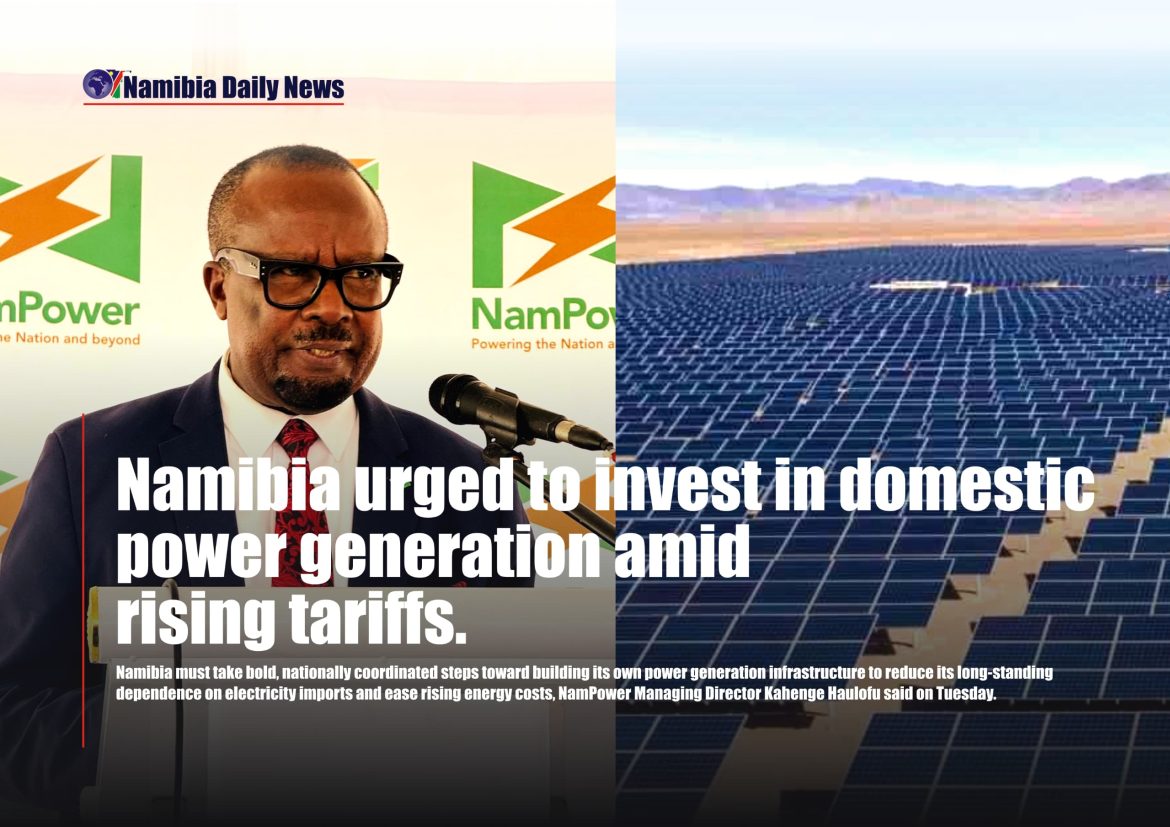
Namibia urged to invest in domestic power generation amid rising tariffs

WINDHOEK, July 9  — Namibia must take bold, nationally coordinated steps toward building its own power generation infrastructure to reduce its long-standing dependence on electricity imports and ease rising energy costs, NamPower Managing Director Kahenge Haulofu said on Tuesday.

Speaking during a joint consultative meeting at the Namibian Parliament, Haulofu warned that unless the country commits to building a domestic base-load power plant, tariffs will remain high and the national energy supply will continue to depend on imports from neighboring countries.

“Tariffs are high, but there are reasons behind it, and unless we take meaningful action, they will likely rise,” Haulofu said. “Namibia has not developed a baseload power plant since time immemorial.

If we don’t act now, we will remain dependent on others.” Haulofu emphasized that current investments in transmission infrastructure and renewable energy, many of them financed by international loans, are valuable but insufficient in ensuring long-term energy stability.

He argued that relying on external financing from institutions, such as the World Bank and the German state-owned KfW Development Bank, is not sustainable without a broader national commitment.

“We cannot depend on NamPower securing small loans alone. The nation must come together to fund and build a national power plant. The money we get is largely used to buy electricity and pay for transmission.

Without domestic generation, this cycle will continue,” he said. Namibia imports between 60 and 70 percent of its electricity from neighboring countries, including South Africa, Zambia, and Zimbabwe.

Despite strides in expanding solar and wind power generation, much of its supply remains intermittent and insufficient to meet the rising demand.

Although projects such as the Omburu Solar PV Plant and the Baynes Hydro Power Project are underway, the absence of a large-scale, stable baseload power station has left Namibia vulnerable to regional supply shocks and tariff volatility.

Haulofu also raised concerns about the unregulated expansion of solar projects nationwide, cautioning that indiscriminate solar installation could strain the national grid, which has a limited capacity to absorb intermittent power.

“Everyone wants to install solar everywhere, but our grid has limitations. Solar energy must be integrated responsibly, knowing that it is intermittent and requires proper management,” he added. (Xinhua)

July 9, 2025 0 comment
0 Facebook Twitter Google + Pinterest
Join Us in Nurturing Young Minds at Innocentia Likoro Kindergarten

NDIYONA, 9 July — INNOCENTIA LIKORO Kindergarten, located 145 km from Rundu, has been nurturing young minds since its re-establishment on February 8, 2021.

Currently enrolling 44 children aged 3 to 5, the kindergarten promotes skill development in a makeshift zinc building (kambashu) , traditional building with ample outdoor play area, supported by a committed team of two teachers.

To improve facilities and education quality, the kindergarten urgently seeks contributions for permanent structures, fencing, latrine materials, and food provisions, beyond the current N$30 monthly fee per child.

The institution calls on the community to assist in shaping brighter futures for these children. For donations or inquiries, contact Mr. Kudumo Eusebius at [+264 81 704 2395] or innocentiakindergarten@gmail.com- Namibia Daily News.

July 9, 2025 0 comment
0 Facebook Twitter Google + Pinterest
BRICS moves to expand Global South cooperation for inclusive, sustainable global governance

RIO DE JANEIRO, July 8– Leaders of BRICS countries, gathering here on Sunday and Monday for the 17th BRICS Summit, reiterated their commitments to reforming and improving global governance by expanding Global South cooperation.

The meeting adopted the Rio de Janeiro Declaration, which calls for strengthening multilateralism and reforming global governance, promoting peace, security and international stability, as well as deepening international economic, trade and financial cooperation.

Addressing the summit’s plenary session themed “Peace and Security and Reform of Global Governance” on Sunday, Chinese Premier Li Qiang called on BRICS countries to strive to become pioneers in advancing the reform of global governance, safeguard world peace and tranquility, and boost the peaceful settlement of disputes.

In 2015, Chinese President Xi Jinping put forward the global governance vision of extensive consultation and joint contribution for shared benefit, offering China’s solution to the global governance challenge.

Ten years on, the vision has gained growing global influence as transformations unseen in a century are accelerating in the world.

“The world has entered a new phase of major turbulent changes, and the international order is undergoing a significant reorganization.

Following its expansion, the BRICS mechanism will unite efforts to promote common development, defend multilateralism and contribute more to building a more equitable global governance system,” said Boris Guseletov, a senior researcher at the Institute of European Studies of the Russian Academy of Sciences.

Li also called for commitment to building an open world economy and stressed the importance of opposing unilateralism and protectionism when addressing the plenary sessions.

The Chinese premier noted that the current international economic and trade order, along with the multilateral trading system, is facing severe challenges, and the global economic recovery remains arduous.

Greater BRICS cooperation must stay true to its founding purpose, meet the needs of the times, uphold and practice multilateralism, promote the establishment of an equitable and open international economic and trade order, pool efforts in the Global South, and make greater contributions to global stability and development, he said.

Amid rising global trade tensions, the 17th BRICS Summit toughened the bloc’s key role in promoting fairer economic practices, said Balew Demissie, a researcher with the Ethiopian Policy Studies Institute.

BRICS offers a unified platform that supports multilateral trade, promotes intra-bloc commerce and facilitates the use of local currencies, thus reducing reliance on limited markets, he added.

The leaders attending the plenary sessions agreed that the BRICS cooperation mechanism has been growing stronger and more representative, with its international influence rising steadily.

It has provided an important platform for Global South countries to defend their right to development, uphold international fairness and justice, and participate in the reform of the global governance system, they said.

“BRICS is increasingly shaping global debates on development, multipolar governance and security matters,” said South African President Cyril Ramaphosa on Sunday.

“With our broad geographical footprint and growing influence, BRICS is uniquely positioned to advocate for reform in global governance structures.”

Malaysian Prime Minister Anwar Ibrahim said in a statement that BRICS, which has emerged as a strong and principled force, represents an opportunity to shape a more balanced and just international order, noting that legacy international organizations need to be reformed to reflect the changing global realities and take into account the aspirations of developing nations.

Furthermore, the expansion of BRICS symbolized a qualitative leap in its representativeness and influence. In January this year, Indonesia, the largest economy in the Association of Southeast Asian Nations (ASEAN), officially joined BRICS.

By now, BRICS countries account for over half of the world’s population, nearly 30 percent of global GDP, and more than 50 percent of global economic growth.

This signifies a historic shift of the Global South power from the periphery to the center of the international arena.

“If we want the international system to be more diverse, fair and democratic, it is important that the Global South has more power to act and have a voice,” said Alessandra Scangarelli Brites, editor-in-chief of Brazil’s Intertelas Magazine.

“This does not mean fighting for power to have control over others, but to have equal action and to have its positions and interests heard and met in a space of greater equality, independence and respect for the sovereignty of countries,” the editor-in-chief added.

During talks with other leaders on the sidelines of the summit, the Chinese premier voiced China’s readiness to push for a greater role of the Global South in improving global governance.

When meeting with Brazilian President Luiz Inacio Lula da Silva a day before the summit, Li said China is willing to enhance communication and coordination with Brazil within multilateral frameworks such as the United Nations, BRICS and the G20, work in unity with developing countries to promote an equal and orderly multipolar world and a universally beneficial and inclusive economic globalization, and provide more certainty and stability for the world.

In his meeting with Ethiopian Prime Minister Abiy Ahmed, Li noted that both China and Ethiopia are important Global South countries, and China will join hands with Ethiopia to strengthen communication and coordination within multilateral frameworks, boost concerted efforts by all parties to practice true multilateralism, firmly safeguard economic globalization and free trade, and inject more stability and positive energy into the world.

After the plenary sessions, Li met with Director-General of the World Trade Organization (WTO) Ngozi Okonjo-Iweala and said China will, as always, continue to practice and safeguard multilateralism and free trade, actively support the reform and development of the WTO to restore its authority, accelerate the improvement of trade rules, and push for more concrete outcomes of the 14th WTO Ministerial Conference.

“Instead of unilateralism and protectionism, the BRICS countries reaffirmed the importance of cooperation and an open economy so that all countries can achieve development and collective security,” said Marcos Cordeiro Pires, a professor of political and economic sciences at the Faculty of Philosophy and Sciences of the Sao Paulo State University.

BRICS countries are striving for new global governance and a global framework that is inclusive, representative and anchored in the principles of sovereignty, equality and peaceful coexistence.

“The demand for new global governance is not a whim, but a process of historical reparation. The BRICS offers a platform for inclusive cooperation, removed from hegemony and closer to the principles of multipolarity,” said Jhonathan Mattos, an associate professor at the Department of International Relations, Rio de Janeiro State University.

“It’s a model of multilateralism, multipolarity, regional integration and the identity of shared demands,” Mattos said. (Xinhua)

July 8, 2025 0 comment
0 Facebook Twitter Google + Pinterest
Enhancing Agricultural Skills in Namibia Through Chinese Collaboration

By John K WaDisho

Namibia’s agricultural sector stands at a pivotal crossroads. As the country seeks to boost food security, create jobs, and modernize farming practices, international partnerships have emerged as key catalysts for progress. Among these, “win-win” collaborations with the Chinese government hold immense promise for advancing Namibia’s agricultural ambitions and strengthening skills transfer.

What Does a Win-Win Partnership Mean?

A win-win partnership is more than just cooperation—it’s about creating mutual benefits where both parties gain value. For Namibia and China, this means leveraging each other’s strengths: Namibia’s vast arable land and eager workforce, paired with China’s technological expertise and investment capacity.

Modernizing Namibia’s Agriculture

Chinese agricultural technology and investment have helped transform rural economies worldwide. In Namibia, joint projects have introduced modern irrigation, improved seed varieties, and advanced farming equipment. These innovations increase yields, optimize water use, and help local farmers withstand climate shocks—a crucial need in a country often affected by drought.

Skills Transfer: Empowering Namibians

A core advantage of Namibia-China cooperation is skills transfer. Chinese experts regularly conduct workshops and hands-on training for Namibian farmers, students, and agricultural workers. These programs go beyond theory, empowering locals to apply new techniques, manage modern machinery, and adopt sustainable practices. As Namibians gain these skills, they not only boost agricultural productivity but also become innovators and leaders within their own communities.

Mutual Growth and Economic Opportunity

The benefits flow both ways. For China, Namibia offers a reliable trade partner and access to unique agricultural products. For Namibia, increased productivity means greater food security, reduced import costs, and access to new export markets. As rural agribusiness expands, local economies grow and new jobs are created—fostering prosperity for all partners involved.

Ensuring a Sustainable, Inclusive Future

To realize the full potential of these partnerships, it’s vital to ensure transparency, fair participation, and environmental stewardship. Win-win means everyone’s interests are respected: Namibian farmers have a strong voice, local ecosystems are protected, and projects align with Namibia’s long-term development goals.

Sowing the Seeds of Shared Success

In the spirit of win-win cooperation, partnerships with the Chinese government are helping Namibia’s agricultural sector flourish. By combining resources, expertise, and a shared vision for the future, both nations are cultivating not only crops—but knowledge, opportunity, and lasting prosperity-

(John K WaDisho is a political correspondent of Namibia Daily News and wrote on his personal capacity)

July 8, 2025 0 comment
0 Facebook Twitter Google + Pinterest