

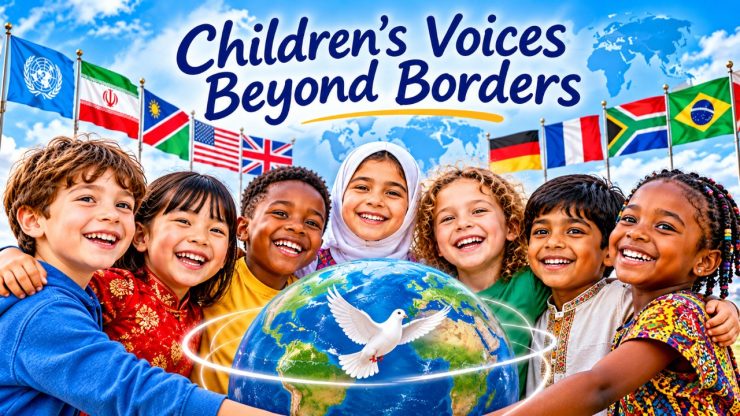
The Common Heritage of Humanity at Risk
Childhood should be the safest and purest chapter of human life. Beyond all geographical borders, race, language or beliefs, children represent innocence and the bright future of our planet.
Yet, as we approach World Children’s Day on 20 November, we turn the pages of the calendar at a time when this occasion has become less a celebration of children’s growth and well-being and more a painful wake-up call to the conscience of the international community and international human rights institutions.
In a world that claims to stand for progress and democracy, warmongering policies and state terrorism have ruthlessly targeted their most defenceless victims: children.
This human tragedy is not confined to one particular place. From the deep and enduring suffering of children and school students in Iran, following military aggression and attacks by the terrorist US military and the Israeli regime—which have left families mourning the tragic deaths of young girls in horrific incidents, including the attack on Shajareh Tayyebeh School in Minab and the Lamerd Volleyball Hall—to the heart-rending cries of innocent children in Gaza, Yemen, Afghanistan, Iraq, Lebanon, Syria and other conflict-stricken parts of the world, the suffering is widespread.
These shocking images bear witness to a bitter truth: military violence and terrorism recognise no red lines when it comes to taking the lives and destroying the futures of generations yet to come.
Shared Suffering, Double Standards and the Responsibility of Consciences
What is unfolding today across the world, from the Middle East to other regions, is far more than dry political statistics and figures. It is a story of shattered innocence and children losing their lives in bloodshed, children who had the natural and undeniable right to grow up in a world free from the shadow of war and threats.
Even more painful than the tragedies themselves is the deafening silence of international institutions and the double standards applied in addressing human rights.
When state aggressors and terrorist armies operate with complete impunity, targeting infrastructure, schools and sports facilities, a fundamental question arises: How long will the standards by which human lives are valued remain tied to the interests of powerful states?
The children of Gaza, buried beneath the rubble of merciless bombardments, the children of Yemen, Afghanistan, Iraq, Lebanon and Syria, and the victims of military attacks in Iran are all members of one large human family. The pain of a child in Minab or Lamerd is no different from that of a child in Gaza or Beirut.
This shared suffering knows no borders; it is a common language understood by all awakened consciences across the world. In this regard, the role of the media, writers and people of the pen in different countries is vital, particularly in free societies that understand the value of independence and the importance of standing against oppression.
This global concern also calls upon us to reflect on the realities around us. In a country such as Namibia, children are among the nation’s most precious assets and deserve deeper attention to ensure better living conditions, higher educational standards, greater access to meaningful educational opportunities, and a safe and nurturing environment in which they can grow and thrive.
Addressing the social challenges facing families—including economic hardships that can sometimes lead to emotional distress and increased vulnerability among children—reminds us of an important truth: improving children’s living environments and protecting the family as a fundamental social institution are collective responsibilities.
Responsible media coverage of these concerns, alongside broader global issues, is an important step towards building a brighter future for the next generation.
Our mission on World Children’s Day must be to break the wall of silence, accurately portray the dimensions of these acts of aggression, and remind the world of one undeniable truth: as long as even one child anywhere in the world remains a victim of war and terrorism, no country’s security and peace can ever be complete.
The Echo of Children’s Voices: A Call for Action and Global Solidarity
World Children’s Day is more than a date on the calendar; it is a call to reassess the path of humanity. When we look into the innocent eyes of children affected by war, military aggression and state terrorism—from the innocent schoolchildren in Iran to the defenceless children of Gaza, Yemen, Lebanon and other parts of the world—we realise that the future of humanity itself is at risk. Silence or inaction in the face of such crimes amounts to allowing violence to continue.
Today, Namibia and other freedom-loving nations around the world, which understand all too well the value of freedom, peace and the struggle against oppression, have an opportunity, more than ever, to take the lead in this moral call for justice.
Let us use the power of culture, art and the media to break the wall of silence and ensure that the voices of these children seeking justice are not lost amid the noise of powerful interests.
As long as the heavy shadow of war and terror hangs over even a single child, world peace will remain an unfinished dream. Ensuring that the voices of children are heard across borders and throughout the world is a shared responsibility that belongs to us all.
By Ahmad Ajorlou – Media Section, Embassy of the Islamic Republic of Iran in Namibia

