

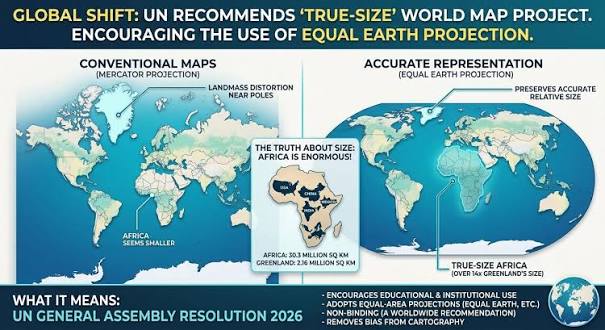
NAIROBI, Sept. 10– How big is Africa? The answer can differ strikingly from one world map to another.
The question has taken on new weight since Sept. 4, when the United Nations (UN) General Assembly adopted a “Correct the Map” resolution by 164 votes to 1, with 6 abstentions. The measure encourages governments, schools, international organizations and technology companies, among others, to make greater use, where appropriate, of map projections that more accurately reflect the relative sizes of the world’s regions.
Analysts say the resolution’s significance reaches well beyond cartography. The initiative, proposed by Togo and endorsed by the African Union (AU) before winning overwhelming support at the UN, is in their view both a rare display of the continent speaking with one voice and a measure of Africa’s growing ability to place its own concerns on the international agenda.
BEYOND THE MAP
On the Mercator projection, Africa — a continent roughly 14 times the size of Greenland — can appear barely larger than the island. Devised in 1569 by cartographer Gerardus Mercator primarily for navigation, the projection preserves angles and directions, making it useful for sailing along a constant bearing. But it inflates regions at high latitudes and visually shrinks Africa and other lands near the equator.
“Maps are never just decorations. They influence education, shape how people perceive the world and the global balance of power,” Togo’s Minister of Foreign Affairs, Cooperation, African Integration and Togolese Abroad Robert Dussey told local media. “Correcting the map means correcting the way we see the world.”
Benjamin Mgana, chief editor of foreign news at The Guardian newspaper in Tanzania, told Xinhua that if generations grow up seeing Africa drawn far smaller than it really is, that long-standing visual impression can quietly shape perceptions of the continent’s weight and its place in the world.
The UN resolution cited the Equal Earth projection, which depicts the continents’ relative sizes more faithfully while keeping the map readable. The AU had earlier endorsed its use.
A more accurate representation of Africa’s size would better convey the continent’s real significance in demography, economics and geopolitics, Lemmy Nyongesa Mulaku, a scholar of international affairs at the University of Nairobi, said in a recent interview.
“Africa must be represented as it truly is: in its true dimensions and in its rightful place in the world,” Mahmoud Ali Youssouf, chairperson of the AU Commission, said in a statement issued on the day of the vote.
The resolution, however, does not brand the Mercator projection as scientifically “wrong.” Dussey stressed that it still has practical uses, including in maritime navigation, and that “no one wants to ban it.”
The initiative, he said, is about whether a projection that skews perceptions of relative size should remain the default in settings such as education, public information and comparisons between continents.
Dussey said Togo would call on governments, schools, international organizations and companies using mapping technology to switch to maps based on the Equal Earth projection. Over the next six months, Togo plans to consult AU member states and supporters in other regions to promote wider adoption.
Education is a key arena for the change, Leon-Marie Nkolo Ndjodo, an associate professor at the University of Yaounde I in Cameroon, told Xinhua. African countries, he said, need to review teaching content in history, geography, philosophy and economics, as well as in strategic, geopolitical and security studies, so that young people grow up with an accurate picture of the continent’s geography.
AFRICA IN ONE VOICE
For the analysts interviewed, the resolution’s adoption means more than international support for a single initiative. It also reflects African countries’ growing effort to voice common concerns collectively and play a more active part in shaping the global agenda.
“For many years, African countries were often seen mainly as responding to agendas set elsewhere. What we are seeing more and more now is Africa trying to put its own concerns on the international agenda and speak with a stronger collective voice,” Mgana said.
“Africa spoke with one voice. That is rare. It is precious. This is pan-Africanism that delivers results,” Dussey said. When a continent of 1.4 billion people comes together to correct the image the world holds of it, “the world listens,” he added.
In a statement issued on last week, Togo’s Ministry of Foreign Affairs, Cooperation, African Integration and Togolese Abroad said the UN vote demonstrated that “when Africa speaks with one voice and advances an advocacy based on rigor and equity, it is able to rally the international community.”
“African countries want greater representation in international institutions, a stronger voice in global decision-making and more space to tell their own stories instead of always being described by others,” Mgana said.
This, he believes, points to a broader reassessment across parts of the Global South of systems, institutions and narratives inherited from the past, and a demand for an international order that better matches today’s realities.
Starting with a map, Africa is out to change both how the world sees it and how it speaks for itself on the world stage. As Gideon Keter, a former member of Kenya’s Parliament, put it: “Our size must finally match our voice, our potential must match our ambition, and our ambition must be matched by action.” (Namibia Daily News / Xinhua)

