

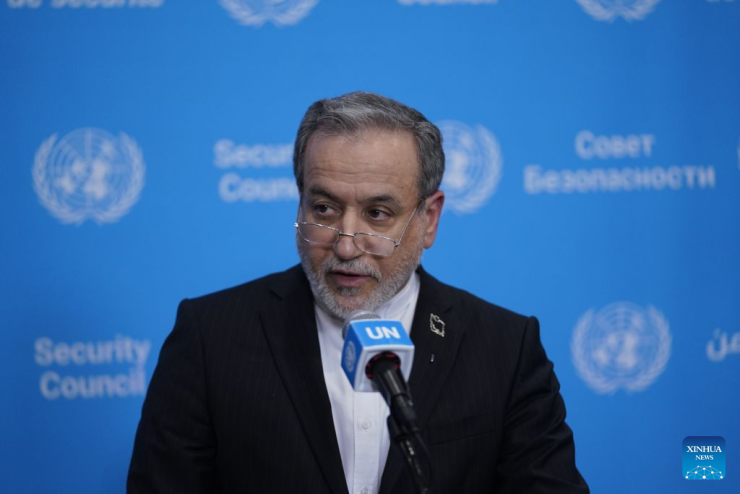
UNITED NATIONS, Sept. 26 — Iranian Foreign Minister Seyed Abbas Araghchi said Friday that his country has conveyed to the United States a plan under which the Strait of Hormuz can be reopened within seven days if necessary conditions are met.
Iran has conveyed “a concrete seven-day plan” to the United States through Qatar, Araghchi told reporters at the UN Headquarters in New York.
The seven-day timeline will start as soon as Washington accepts it, he said.
Under the plan, the United States would need to take certain actions that Iran believes may take four or five days, said Araghchi, adding that on day six, the strait would be open. “And on day seven, the talks with the U.S. will be started for the final deal on mutually agreed subjects.”
He said the actions the United States should take are not new, as they are already included in the memorandum of understanding (MoU) signed in June.
“I can tell you if there is seriousness in the U.S. side to come to a deal and reopen the Strait of Hormuz, everything is now prepared,” said Araghchi.
“The choice now rests with the United States,” he said. “Iran does not accept coercion, threats, or intimidation, and Iran will not surrender its sovereign rights under pressure.”
On June 18, the United States and Iran signed an MoU on ending the war in the region on all fronts, including Lebanon. Under the MoU, they were scheduled to hold negotiations within 60 days, which ended on Aug. 17, to reach a final agreement, but the fate of the talks remains unclear following a series of recent escalations between the two countries.
Araghchi noted that the strait had remained open until the outbreak of the Israeli-U.S. war on Iran on Feb. 28, and that after signing the MoU, Iran immediately began technical discussions with Oman aimed at implementing the commitment and restoring maritime traffic to pre-war levels.
However, subsequent unilateral U.S. measures and military action violated and blocked the implementation of the MoU, he said, adding that Iran has kept the door to diplomacy open.
On Iran’s nuclear program, Araghchi said the allegation that Iran is on the verge of acquiring a nuclear weapon is “a big lie.”
Iran has been a faithful party to the Non-Proliferation Treaty since 1970, and has been subject to extensive monitoring by the International Atomic Energy Agency (IAEA) for decades, he said.
“The United States cannot credibly claim to defend non-proliferation while attacking IAEA-safeguarded peaceful nuclear facilities (in Iran) in clear violation of its international obligations,” said Araghchi. (Namibia Daily News / Xinhua)

