

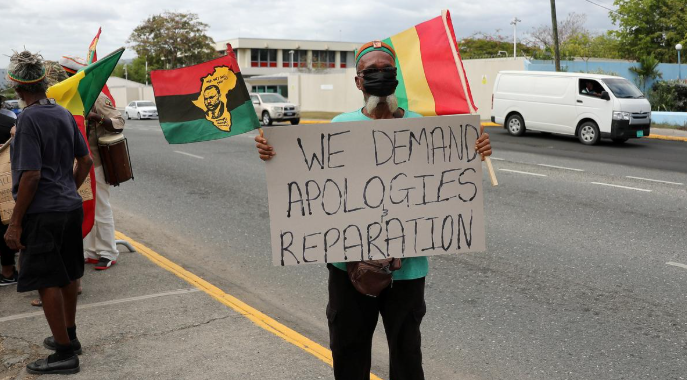
ACCRA, June 19 — African leaders and global advocates for reparative justice have convened in Accra, capital of Ghana, to enhance international efforts to address the enduring legacy of the trans-Atlantic slave trade and advance calls for historical redress.
The high-level consultative meeting from Wednesday to Friday brought together heads of state from Africa and the Caribbean, as well as representatives from the United Nations Educational, Scientific, and Cultural Organization (UNESCO), the African Union (AU), and a French government delegation.
The gathering focused on charting the next steps following the adoption of a landmark United Nations (UN) resolution recognizing the slave trade as one of the gravest crimes against humanity.
Opening the conference on Thursday, Ghanaian President John Dramani Mahama said it is important to enlarge the already broad support that made the passage of the landmark UN resolution on March 25 possible by including a broader community of nations and institutions that are willing to engage in the work that follows.
“Narrowing the circle of participation does not strengthen the pursuit of historical justice. It is strengthened by expanding it. It is strengthened when those who may approach these issues from different historical, political, or legal perspectives, nevertheless, choose dialogue over silence and engagement over distance,” Mahama said.
According to the Ghanaian president, one of the most important lessons from the history of the slave trade is that its consequences have never been confined to a single geographical region but connected continents through pain and suffering.
“The slave trade linked the shores of Africa to the Caribbean and to North and South America and to communities across the world whose identities, cultures, and histories were forever shaped by the forced displacement of millions of Africans,” he added.
Mahama, who is also the AU’s champion on reparations, commended the decision by the assembly of the AU to establish an African-Caribbean joint mechanism on reparative justice.
“The crime we seek to address was transcontinental in its reach. Its consequences remain transcontinental, and the search for justice must therefore be transcontinental.
It is time to move the talk for reparations into action,” the Ghanaian president noted. Amma Twum-Amoah, AU commissioner for health, humanitarian affairs, and social development, said that the approach of the continental body to reparations includes all related crimes, such as the trafficking and enslavement of Africans, colonialism, apartheid, and their ongoing effects like political exclusion, economic exploitation, and cultural and racial discrimination.
“The AU is also concerned about racial discrimination and structural inequality. In this sense, equality and justice are not only about accounting for the past; they are about transforming the systems and structures that the past created, which continue to shape our present,” Twum-Amoah said.
Barbados Prime Minister Mia Amor Mottley reaffirmed the Caribbean Community’s commitment to collaborating with the AU, saying the bloc’s 10-point reparatory justice plan complements African efforts to seek redress for centuries of exploitation and injustice. (Namibia Daily News / Xinhua)

