

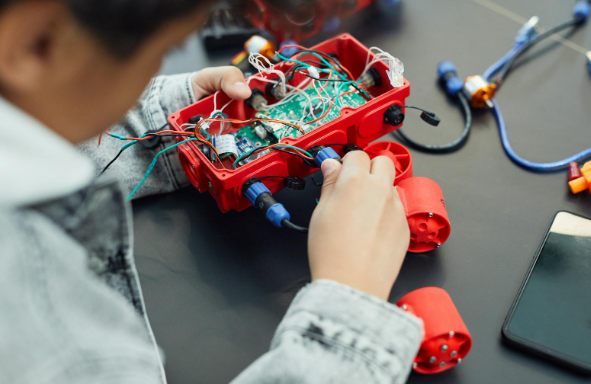
WINDHOEK, April 25 — In a classroom in Namibia’s capital, Windhoek, parents sat beside their children on Saturday, connecting wires, testing wheels and coding small robotic cars in an exercise designed to show how technology can be learned through hands-on activities.
It was part of a Parents Day event hosted by Mindsinaction, a Namibian science, technology, engineering, arts and mathematics (STEAM) education hub that seeks to expose young learners to practical skills in robotics, coding, 3D printing, electronics and other emerging technologies.
For many parents, the session offered a rare chance to experience the kind of hands-on learning their children receive at the center. “I am not that tech-savvy, but I managed to build and code a robotic car.
This is mind-opening,” one parent told Xinhua after completing the task. Mindsinaction was founded in 2018 by two science fair partners, Ndaudika Mulundileni and Andreas Leonard, to help learners engage with science, technology, engineering and mathematics (STEM) through practical activities rather than theory alone.
The organization later expanded its approach from STEM to STEAM, adding arts to encourage creativity alongside technical skills.
At its Windhoek center, Mindsinaction offers structured eight-week modules in areas such as robotics, coding, 3D printing, electronics and computer-aided design for young learners.
During Saturday’s event, instructors demonstrated some of the activities learners undertake during the school year, while parents were invited to become students for the day.
Aina Aipanda, Mindsinaction’s marketing and brand manager, said involving parents is important because many adults did not grow up with access to such technologies and may not fully understand what their children are learning.
“Catch them young is what we believe,” she said, adding that early exposure can help prepare children for a future in which digital and technical skills are increasingly important.
The organization said it has so far delivered hands-on STEAM education to more than 5,000 students across Namibia, working with schools and development partners.
According to Aipanda, practical STEM education remains costly, especially because equipment and learning materials for robotics, electronics and other technology-based programs can be expensive.
She said the hub is open to local and international partnerships that could help improve access to equipment, training resources and technical expertise.
Aipanda said the broader goal is to help bridge the gap between classroom theory and practical problem-solving by encouraging learners to build, test and improve their own ideas.
The hub hopes to take such programs to all 14 regions of Namibia, including communities outside Windhoek, so that more young learners can access practical technology education. (Namibia Daily News / Xinhua)

