

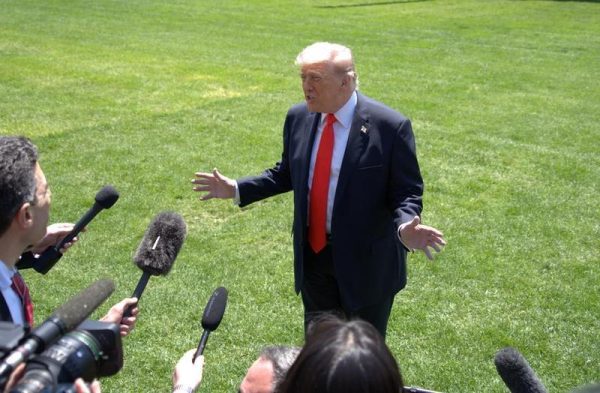
CAIRO, Aug. 17– U.S. President Donald Trump said recently that after the United States finished “defeating Iran,” he would “pretty soon” declare the Strait of Hormuz to be U.S. territory.
The threat came days before the 60-day window for talks aimed at ending the war was set to expire on Monday. Under a memorandum of understanding (MoU) signed on June 18, the two countries agreed to cease hostilities and negotiate a final deal within the 60-day period.
Analysts say the remark is less a thought-out plan to assert sovereignty over the transit waterway than a pressure tactic that risks hardening positions and complicating a return to negotiations.
KEY DISPUTES UNRESOLVED
As the 60-day period comes to an end, neither side appears willing to ease its stance.
After Trump’s remarks, Iranian Foreign Minister Seyed Abbas Araghchi said Saturday that messages were being exchanged between Iran and the United States through mediators, “but this does not mean negotiations at all.”
Araghchi said the June MoU had provided for an end to the war, but accused the United States of violating the agreement, leading to renewed clashes.
The developments suggest that the temporary truce has not resolved the main differences between Washington and Tehran, observers say.
“The fundamental problem is that Washington and Tehran have not addressed their core disagreements,” said Abdulaziz Alshaabani, a researcher at the Al Riyadh Center for Political and Strategic Studies in Saudi Arabia.
He explained that Washington wants Iranian commitments on the nuclear issue, regional security and navigation, while Iran is seeking sanctions relief, measures to address the consequences of the war and preservation of its political standing.
“Each side is waiting for the other to make a concession before offering concessions of its own,” he said, adding the key waterway has thus become part of the wider dispute between Washington and Tehran.
LEVERAGE, NOT A LAND GRAB
Analysts say Trump’s statement on seizing the Strait of Hormuz was more of a pressure tactic than a realistic legal plan.
Adel al-Ghurairi, an Iraqi political analyst and professor at Baghdad University, said the statement could put political pressure on Tehran, strengthen Washington’s position in talks, and send a message to countries concerned about energy security.
“It could also be a negotiating tactic aimed at raising U.S. demands before moving toward more realistic arrangements,” said Ahmed Al-Mufti, a Sudanese international relations expert.
Talk of making the strait U.S. territory could be a message that Washington would not allow Iran to use the waterway as a strategic pressure tool or bargaining chip, he added.
Mustafa Ibrahim, a Palestinian political analyst from Gaza, also viewed the remarks as part of a broader pressure strategy.
Trump has repeatedly relied on maximum pressure, threats and demands as negotiating tools, Ibrahim said, adding the statement should not necessarily be seen as a final legal or military decision.
The remark was more of a Trump’s pattern of making sudden and provocative statements, Alshaabani said.
“Washington wants to emphasize that it will not accept Iran’s unilateral control over one of the world’s most important maritime passages,” he noted.
LIMITS OF HARD POWER
The United States has strong naval, air and intelligence capabilities, but having military influence over the Strait of Hormuz does not automatically turn the waterway into U.S. territory, analysts say.
“The United States can establish naval and air superiority, but maintaining permanent control would be much harder,” Al-Mufti said.
He noted that the narrow shipping lane, Iran’s entrenched military positions along the northern shore, and the sheer cost of a sustained U.S. presence all make long-term control far harder to achieve.
Moreover, any attempt by Washington to claim sovereignty would face strong legal and political opposition from Oman and other countries in the region.
The real question is therefore not whether Washington can project military power in the strait, but whether that power can deliver a political settlement, said Ibrahim.
The analyst noted that if Washington truly wants to end the confrontation, it must shift from coercion and maximum pressure to negotiations that address Iran’s security and political interests.
Tehran, he added, must also recognize that indefinite escalation will only deepen its economic and political predicament. (Namibia Daily News / Xinhua)

