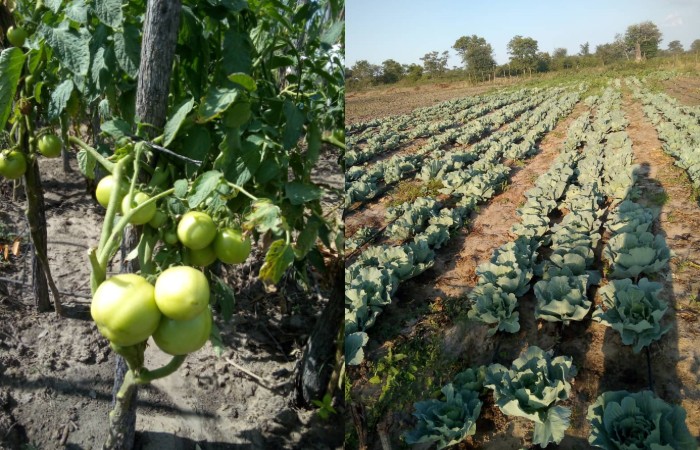
By Cathy Godfrey
KATIMA MULILO, May 6 – The Zambezi Young Farmers Agro-enterprise Development project is an initiative by the Zambezi Horticulture Producers Association (Zahopa). It was designed for the Zambezi youth in the Youth Farming Connect Initiative (YFCI), who intentionally are women.
This initiative is to empower young women to a level of becoming entrepreneurs or local investors in the horticulture industry. And should be regarded as a regional intervention programme that has economic and social implementation aspects. It is to assist the Zambezi region to realise its breadbasket dream, join hands with other game players in the race to accelerate the Zero Hunger Agenda, minimise women and youth unemployment, address rapid urbanisation and counter threats of climate change.
The Zambezi region has the highest unemployment figures (48%) in the country and women and youth are the ones largely affected. Potentially, being the breadbasket, the Zambezi region can leverage agriculture as a sector with the highest comparative advantage. One of the most critical elements of this project is to promote the concept of localised production. Reliable food systems that demonstrate the capacity to reduce the distance between production and consumption. We all know how globalisation accelerates climate change by creating large CO2 footprints in the food transportation industries.
Moreover, enslavement to globalised food systems threatens food security and economies of non-productive localities, when productive localities are confronted with wars and pandemics as we have seen lately. Local production and consumption however, puts the power of food production back in the hands of the local farmers, giving them control over their own food security.
Local businessman, Imran Vadi, has vowed to make available two hectares plus water from one of his three boreholes to four female farmers from YFCI. Another piece of land is at the Ministry of Sport and Youth National Service (MSYNS), where six other young people will be deployed. This project will pay special consideration to 10 young people, between 18 and 35, by providing them with land, water, agricultural inputs and infrastructure and connecting them to training, funding and sustainable markets.
An offset market is critical to the sustainability of the horticulture industry, especially when there is scaled up production. Therefore, Zahopa, with the support of its key stakeholders, has engineered an informal direct sales model – an open-air flea market and the annual Zambezi Horticulture Farmers Trade Fair (ZHFTF) which will be integrated into the value chain. The trade fair, flea market and direct sales will serve to bring markets back into the hands of these young farmers.
The trade fair and flea market will continue to require close input from the local authority in terms of making space available. Additionally, Zahopa has created two virtual hubs on WhatsApp and these social platforms have moved fresh produce around and even across the region. The idea to create an e-market space will be an added advantage for all our farmers, especially youth who are very well acquainted with the functionalities of hi-tech gadgets to market food beyond their localities.
The project will run for three years to allow participants enough time to grab opportunities for better integration into their respective communal land as local investors. Thereafter, another group of 10 young people will be inducted into the project on the original plots allocated.
A part of this project will be supported by World Food Programme, Namibia (WFP) through agricultural inputs, for a period of six month. Organisers are hopeful that the Namibian Agronomic Board (NAB) and other stakeholders will come on board as the project matures. And Good Samaritans willing to support the initiative are invited to come forward as there is still much that is needed.
Regrettably, there are innumerable challenges to Zambezi’s agriculture, especially when it comes to the youth, such as a lack of reliable water sources; land and poor soils; an absence of outlets specifically designed to supply agricultural inputs; an absence of needed technologies that can scale up primary production; an absence of value chain infrastructure; lack of training; and a lack of funding.
Complex initiatives like these that can respond positively to both the economic and social frameworks of the Zambezi region require a collective effort. And synergetic collaborations between key players in the food sector should be encouraged. The deficiency of youth involvement in agriculture is also an aspect that should be addressed in order to accelerate the breadbasket dream. – Namibia Daily News