

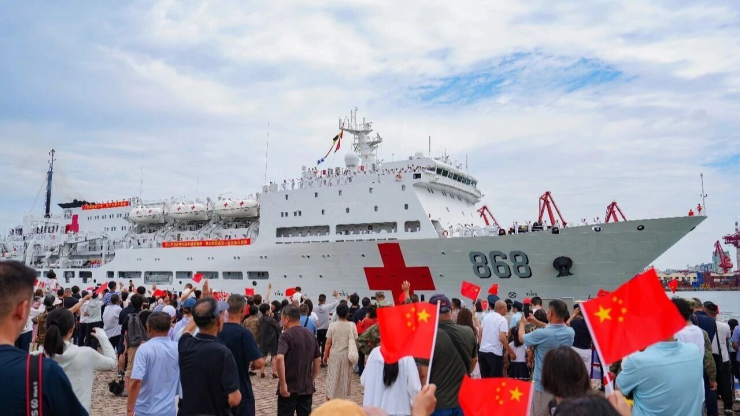
QINGDAO, July 22– The Chinese People’s Liberation Army (PLA) Navy hospital ship, Auspicious Ark, departed from a port in Qingdao, east China’s Shandong Province, on Wednesday for a humanitarian medical service mission in Africa and South Asia.
Mission Harmony-2026, the 12th iteration of Mission Harmony since 2010, is scheduled to last over 200 days, during which the ship will visit multiple African and South Asian countries to provide free medical services to local populations. The crew will also carry out cultural exchanges with relevant countries.
This initiative aims to enhance traditional friendship and pragmatic cooperation between China and relevant countries, provide the international community with more public security products, better implement the Global Security Initiative, and contribute to building a maritime community with a shared future, according to a prior statement from China’s Ministry of National Defense.
Equipped with 18 clinical departments and five auxiliary diagnostic units, the ship is capable of performing more than 60 types of medical examinations, treatments and procedures spanning general surgery, orthopedics, obstetrics and gynecology, ophthalmology and more.
Its eight onboard standard operating rooms support simultaneous surgeries, while an onboard helicopter enhances its emergency medical rescue capabilities.
The voyage is the first overseas mission for Auspicious Ark, China’s third domestically designed and constructed 10,000-tonne-class ocean-going hospital ship. The medical team is composed primarily of medical personnel from the PLA Northern Theater Command Navy, along with members from the Naval Medical University and other units.
Mission Harmony is an overseas humanitarian medical service program organized by the PLA Navy. The first 10 missions were carried out by the hospital ship Peace Ark, and the 11th mission, which began in 2025 and concluded in April this year, was conducted by Silk Road Ark.
According to sources from the mission command, to better prepare for this mission, relevant personnel, drawing on experience from previous deployments and frontline medical needs, have reviewed extensive medical literature and public health data on target regions, identifying prevalent and high-incidence diseases among local populations and tailoring inventories of medical supplies, consumables and pharmaceuticals accordingly to meet the healthcare needs they are likely to encounter there. (Namibia Daily News / Xinhua)

