

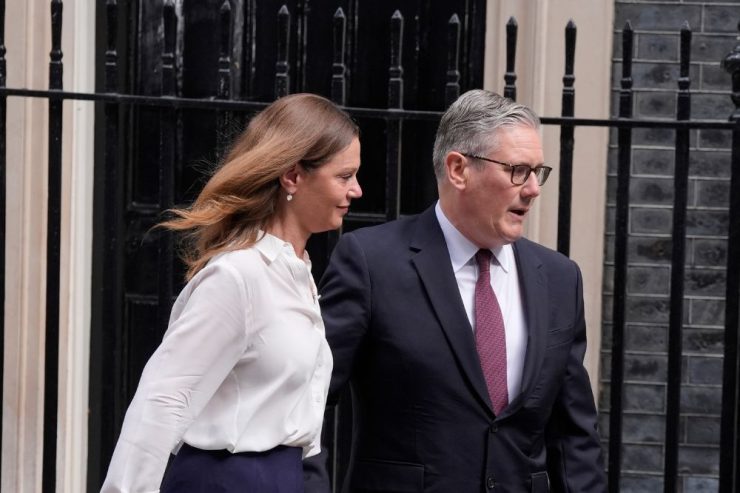
LONDON, June 22– British Prime Minister Keir Starmer announced on Monday that he would resign as leader of the governing Labour Party and leave office once a successor is chosen.
Less than two years ago, Starmer led Labour to a landslide election victory that ended 14 years of Conservative rule. His early departure under mounting pressure from within Labour exposed the party’s governing difficulties and adds uncertainties to a prolonged political instability in Britain.
Analysts said the emphatic victory of Andy Burnham, then the mayor of Greater Manchester, in the recent Makerfield parliamentary by-election triggered Starmer’s resignation, but Britain’s deeper economic and political problems will confront whoever succeeds him.
FROM WINNER TO LOSER
Starmer entered Downing Street in July 2024 promising “change,” faster economic growth, better public services and tighter control of illegal immigration. Yet his government soon became caught between efforts to limit public spending and demands from Labour lawmakers, trade unions and traditional supporters for greater social investment.
Moves to restrict winter fuel payments for pensioners and reform disability benefits provoked strong opposition. Subsequent concessions and policy reversals brought further criticism that the government lacked a clear direction.
The controversy surrounding former British Ambassador to the United States Peter Mandelson’s links with the late U.S. financier Jeffrey Epstein also raised questions about Starmer’s political judgment. The departure of senior Downing Street aides further weakened confidence in his administration.
What dealt another critical blow to Starmer were Labour’s heavy losses in May’s local and regional elections as Reform UK challenged it from the right, particularly on immigration, while the Green Party attracted some disillusioned voters on the left.
Stuart Wilks-Heeg, a political expert at the University of Liverpool, told Xinhua that Starmer could no longer remain in office once large numbers of Labour lawmakers and senior cabinet members concluded that he had to go.
“If you don’t have the command of your parliamentary party, you really are in trouble as a prime minister,” he said.
Wilks-Heeg said Starmer had succeeded in transforming Labour from a party widely considered unelectable after its 2019 defeat into the 2024 general election winner. However, he was unable to transfer that success into governance, with repeated policy reversals and “unforced errors” steadily eroding his authority.
BURNHAM EMERGES AS FRONT-RUNNER
Burnham is widely regarded as the front-runner to succeed Starmer. He previously served as culture secretary and health secretary under former Prime Minister Gordon Brown and twice ran for the Labour leadership.
Burnham has returned to the House of Commons after winning the Makerfield by-election on Friday. On Monday, he voiced willingness to be “part of this process,” referring to the selection of Starmer’s successor.
Former Health Secretary Wes Streeting, previously regarded as a potential contender, expressed support for Burnham and called on other Labour figures to back him.
Burnham’s victory in Makerfield, where he defeated the Reform UK candidate Nigel Farage by a wide margin, strengthened his claim that he could halt the adversary’s advance. “It was almost like a jolt of electricity back into the Labour Party,” said David Bailey, an economics professor at the University of Birmingham.
Ian Scott, a professor at the University of Manchester, said Burnham combines long political experience, strong regional popularity and a direct style that resonates with voters. However, moving from Greater Manchester to Downing Street would be a major test. “He’s got an awful lot to prove,” Scott said.
Burnham’s policy agenda may distinguish him from Starmer, but it also raises questions about how additional investment and public service reform would be financed.
“The new prime minister faces a lot of the same constraints that the previous one faced,” Steve Nolan, a senior lecturer in economics at Liverpool John Moores University, said, adding, “There is wiggle room to play with, but not much.”
Britain’s Office for Budget Responsibility forecast in March that the country’s economy would grow by just 1.1 percent in 2026. Official statistics also showed that output per worker fell by 0.1 percent year on year in the first quarter.
Nolan also noted bond markets would pay particular attention to whether the next government remained committed to Britain’s fiscal rules. High public debt and elevated borrowing costs would make any attempt to loosen those rules a “serious constraint” for a new leadership.
SET FOR SEVENTH PM IN DECADE
Starmer’s stepping down means his successor will become the seventh prime minister to enter Downing Street in roughly a decade since the 2016 Brexit referendum, highlighting the instability at the top of British politics.
Nolan said such frequent changes “do not signal a stable political economy.” He argued that replacing the prime minister does not alter Britain’s underlying conditions, as any new leader will face the same constraints of weak growth and public services.
Yang Fang, a researcher at the China Institutes of Contemporary International Relations, said tensions between Britain’s political system and party culture and the needs of its modern economy and society have weakened governance and fueled public dissatisfaction.
“Both Labour and the Conservatives have responded to crises by changing leaders to preserve power, but this approach cannot resolve deeper structural problems and instead risks creating ‘a low-efficiency cycle of repetition,'” she said. (Namibia Daily News / Xinhua)

