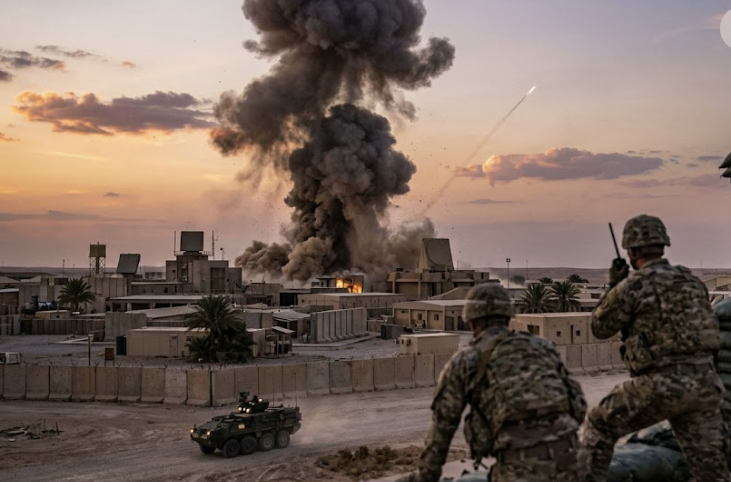
TEHRAN, May 28– Iran’s Islamic Revolution Guard Corps (IRGC) said it carried out strikes Thursday morning targeting a U.S. air base in response to early U.S. attacks against the southern Iranian port city of Bandar Abbas.
The IRGC said in a statement posted on its official news outlet Sepah News that a U.S. air base was targeted at 4:50 a.m. local time (0120 GMT) after what it described as a U.S. attack using aerial projectiles on an area near Bandar Abbas airport in the early hours of Thursday, adding the retaliatory attack was a stern warning.
Three explosions were heard east of Bandar Abbas on the Strait of Hormuz at around 1:30 a.m. Thursday (2200 GMT Wednesday), Iran’s semi-official Fars news agency reported.
Multiple U.S. media outlets reported later that the U.S. military carried out fresh overnight strikes in Iran, targeting a military site that Washington said posed a threat to U.S. forces and commercial vessels in the region.
Citing a U.S. official, CBS News said U.S. forces also intercepted drones launched from Iran. The official described the strikes as defensive, asserting that the ceasefire between the United States and Iran is still considered to be in place.
Citing military sources, Iran’s semi-official Tasnim news agency said on Thursday the United States launched the strikes after Iranian naval forces had stopped and returned four vessels seeking to cross the Strait of Hormuz without permission by firing warning shots.
Iran’s Tasnim news agency cited a military source as saying that the IRGC Navy fired toward a U.S. oil tanker that was trying to transit the strait, forcing it to turn back. The source said the U.S. military then struck open ground around Bandar Abbas, with no casualties or damage reported.
Iranian Foreign Ministry spokesman Esmaeil Baghaei said on social media on Thursday that Iran strongly condemned what he described as U.S. military aggression against the Bandar Abbas region, repeated violations of the ceasefire agreement, and threatening remarks directed at Iran and some countries in the region. (Namibia Daily News / Xinhua)