

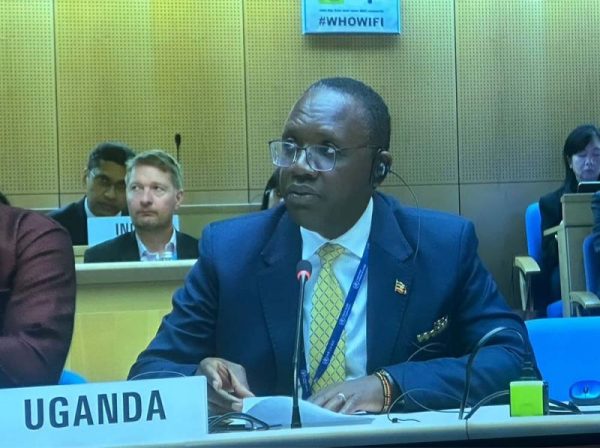
ENTEBBE, Uganda, May 27– As an Ebola outbreak expands in the eastern Democratic Republic of the Congo (DRC) and cross-border infections occur in Uganda, a leading Ugandan scientist has called for calm and a coordinated public health response rather than panic.
Pontiano Kaleebu, executive director of the Uganda Virus Research Institute, which hosts a regional reference laboratory, said in a recent interview with Xinhua that the region has dealt with similar outbreaks before and has successfully contained them through coordinated action and with international support.
His remarks came as the World Health Organization (WHO) warned that Ebola response efforts are struggling to keep pace with the rapidly evolving outbreak, amid rising concerns about further spread across the region.
Kaleebu, who was involved in previous responses to Ebola and other viral hemorrhagic diseases in Uganda, said although the current Bundibugyo strain, unlike the Zaire strain, has neither an approved treatment nor a vaccine, patient management remains broadly similar.
“When people fall sick without drugs, the management is the same. You manage their conditions. If they need fluids, you give them. If they need blood, you give them, so that they survive and don’t go into organ failure and death,” he said.
Kaleebu stressed that Ebola differs significantly from COVID-19 in terms of transmission risk.
Unlike COVID-19, which spreads through the air, Ebola is transmitted through direct contact, meaning infections can be prevented if public health guidance is followed, he said.
Kaleebu also urged the public to promptly report suspected infections and seek medical attention if Ebola-like symptoms develop following contact with a suspected case.
He noted that countries in the region, including Uganda, have significantly strengthened their outbreak preparedness over the years by expanding laboratory capacity and training health workers.
According to Kaleebu, Uganda has reactivated its Ebola laboratory in Arua District in the northwest near the DRC border and established a mobile Ebola laboratory in Bwera, Kasese District, also bordering the DRC.
The facilities are intended to speed up testing of suspected cases, reducing the need to transport samples to the main laboratory in Entebbe, about 40 km south of the capital, Kampala.
Kaleebu called on the international community to increase funding for public health emergencies, saying sustained financial support is essential to containing outbreaks such as the current Ebola situation.
“We need the resources, especially now like in the DRC. It really needs some good financing to ensure that it is contained,” he said.
Large-scale resources are needed to strengthen surveillance, screening and contact tracing along the porous Uganda-DRC border, especially as parts of the eastern DRC continue to experience conflict and instability, Kaleebu said, adding that frequent cross-border movement of people and goods further raises the risk of regional transmission.
“The circumstances are a little bit challenging because the outbreak is mostly in (DR) Congo where there is war and instability that makes it challenging. People are moving. I think that is a major issue,” he said.
Kaleebu said that continued regional and international coordination, together with timely mobilization of resources, would be key to reversing the upward trend in infections.
Financial commitments to supporting the Ebola response had been made at a recent regional ministerial meeting attended by the Africa Centers for Disease Control and Prevention, WHO and other partners, Kaleebu noted.
Uganda’s ability to prevent wider transmission, he said, is closely linked to the effectiveness of the response in neighboring DRC.
“If your neighbor’s house is on fire, then yours is also at risk. The fire could cross.”

