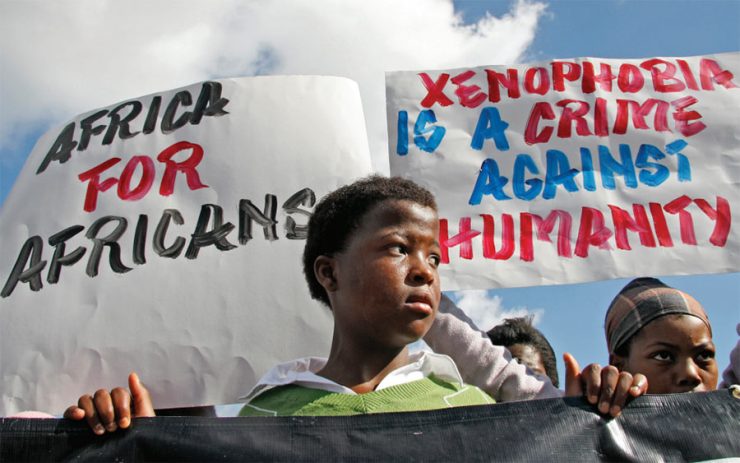
JOHANNESBURG, May 5 — Along the crowded streets of Hillbrow and the central business district of Johannesburg, the usual rhythm of informal trade has been greatly disrupted.
Local and foreign vendors say recurring waves of xenophobic tension have not only threatened their safety but also their revenue streams, prompting renewed calls for decisive government intervention.
For many traders, Hillbrow and central Johannesburg represent business opportunities, said Miriam Dlamini, a South African vendor. The area’s dense population and constant pedestrian traffic have long made it a hub for small-scale commerce, she said.
However, in recent weeks, fear has increasingly crept into daily life amid a renewed wave of xenophobic tensions.
Since late April, widespread protests against illegal migration have occurred in major cities like Johannesburg, Pretoria and Durban. These have sometimes turned violent, involving attacks on foreign-owned businesses and individuals.
“I have been selling vegetables here for eight years,” said Dlamini. “We used to work side by side, locals and foreigners. Now there is suspicion, and sometimes violence. It is bad for everyone.”
Foreign nationals, many of whom rely on informal trading as their primary source of income, say they feel particularly vulnerable.
Joseph Mwamba, a vendor from the Democratic Republic of the Congo, described how tensions can escalate rapidly.
“Some days you hear rumors, and suddenly people start running. Shops close, goods are looted. You don’t know if you will make it home safely,” Mwamba said. “We are here to work, not to fight.”
Analysts say misinformation and perceptions that foreign nationals take jobs or contribute to crime have further fueled tensions, despite evidence that many migrants play a significant role in the informal economy.
Several vendors in Hillbrow recounted incidents in which stalls were damaged or goods looted during unrest. Others said they had temporarily shut down operations out of fear, losing critical income.
Local traders emphasized that xenophobia harms the broader community, not just foreign nationals.
“When violence starts, customers disappear,” said Sipho Nkosi, who sells clothing in central Johannesburg. “We all lose business. It doesn’t matter where you come from.”
Community leaders in Hillbrow have echoed these concerns, warning that persistent tensions could destabilize one of Johannesburg’s most economically active inner-city areas.
Vendors are now urging authorities to take stronger and more visible action to address the root causes of xenophobia, including unemployment, crime and misinformation.
“We need protection, but we also need education,” said Liberty Manunure, another vendor. “People must understand that we are part of this economy.”
Some traders have called for an increased police presence, while others advocate dialogue initiatives that bring together local residents and foreign nationals to rebuild trust.
Xenophobic violence has periodically flared in South Africa over the past two decades, often driven by a complex mix of high unemployment, poverty and competition over limited economic opportunities.
Major outbreaks in 2008, 2015 and 2019 left dozens dead, displaced thousands and damaged small businesses, particularly those owned by foreign nationals from other African countries.
The South African government has repeatedly condemned xenophobic violence and launched initiatives aimed at promoting social cohesion and peaceful coexistence.
However, critics argue that implementation has been inconsistent and that underlying socio-economic challenges remain largely unaddressed.
“We just want peace,” said Joel Mashuranga. “We want to work, support our families, and live without fear. The government must help make that possible.”
With rising xenophobic attacks in South Africa, some African countries, including Nigeria and Ghana, have issued diplomatic protests to Pretoria about the alleged mistreatment of their citizens.
Nigeria, one of the countries with a significant number of nationals living and working in South Africa, has repeatedly expressed concern over the safety of its citizens during periods of unrest.
Following previous waves of xenophobic violence, the Nigerian government facilitated the voluntary repatriation of hundreds of its nationals.
Nigerian authorities have also urged South African officials to ensure the protection of foreign nationals and uphold the rule of law, while calling on their citizens to remain law-abiding and avoid actions that could inflame tensions.
In downtown Johannesburg, Nigerian vendor Chinedu Okafor, who sells phone accessories, said unity among Africans is essential to overcoming divisions.
“We are all Africans at the end of the day,” he said. “We should not fight each other because of where we come from.”
“We must live together, support one another and build this economy together. Peace is the only way forward,” Okafor said. (Namibia Daily News / Xinhua)