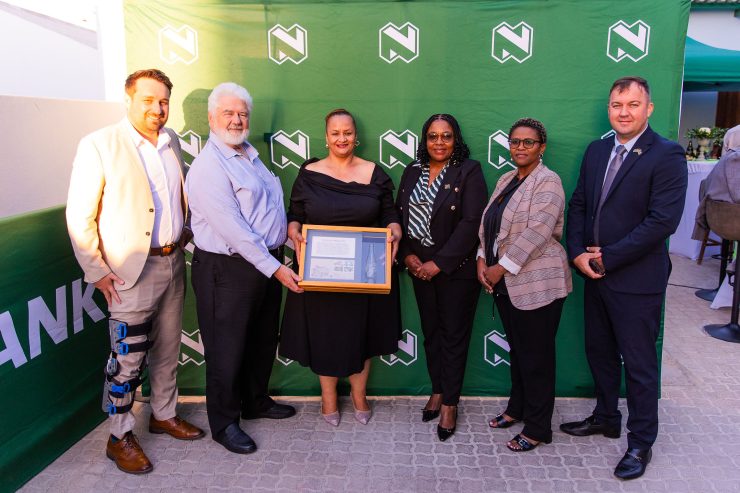
Windhoek, April.27 — For decades, Lüderitz has been known as a resilient coastal town defined by its fishing heritage, maritime character and tourism appeal.
Today, it stands at the centre of one of Namibia’s most profound economic shifts. Driven by offshore oil and gas discoveries, green hydrogen ambitions and critical minerals logistics, Lüderitz is rapidly evolving into a strategic industrial and export hub for the southern corridor.
This transition is not speculative – it is already being anchored by billion‑dollar infrastructure plans and international partnerships aimed at long‑term growth.
As Lüderitz redefines its economic role, 1 truth is clear: infrastructure alone does not unlock growth – financial systems do. Banking is no longer a back‑office function in this new frontier – it is a strategic enabler of investment and collaboration.
That is where Nedbank Namibia’s deliberate revamp of its Lüderitz branch becomes more than an operational upgrade and is a statement of intent.
Lüderitz: From coastal town to strategic gateway
Recent developments are repositioning Lüderitz as a critical node in Namibia’s future economy. The planned expansion of the Port of Lüderitz at Angra Point, supported by the European Union and the Port of Rotterdam, is laying the groundwork for green minerals, hydrogen and oil and gas logistics exports. This planning phase alone carries significant value, with follow‑on investment potential running well into the billions. Foreign interest in renewable energy projects indicates that Lüderitz is transitioning towards an infrastructure‑led growth model rather than one driven purely by traditional commerce.
These shifts bring complex financial requirements: cross‑border capital flows, foreign exchange management, trade finance, large project funding, and the integration of local suppliers into international value chains.
Why banking is central to this new economic paradigm
Large investments do not materialise overnight. They progress through cycles, feasibility, planning, construction, operation and each stage depends on reliable, adaptive financial partners. Investors need banks that understand Namibia’s regulatory environment, its development priorities, and the realities of operating in an emerging industrial zone.
At the same time, local businesses in Lüderitz, contractors, logistics providers, accommodation operators, engineers and service small and medium enterprises must scale responsibly to meet international standards. This requires financial partners who can provide not just capital, but insight, stability and long‑term collaboration.
In this environment, banking becomes the connective tissue linking global ambition with local capability.
Nedbank Namibia’s decision to revamp its Lüderitz branch as part of its Project Imagine initiative reflects a forward‑looking recognition of this new reality. Rather than viewing Lüderitz as a peripheral market, Nedbank is positioning itself at the heart of the southern corridor’s transformation, where capital and opportunity converge.
Speaking to the bank’s intention, Nedbank Namibia Communications and PR Manager, Selma Kaulinge, notes: ‘Lüderitz is entering a new phase of economic relevance for Namibia, one defined by long‑term investment, international collaboration and development. Underscored by our ethos of being money experts who do good, our responsibility is to ensure that our clients, stakeholders, investors and local businesses have a banking partner that understands this complexity.’
By strengthening its Lüderitz presence, Nedbank Namibia positions itself not only as a financier of projects, but also as a partner who ensures that growth in the south benefits clients, communities, businesses and investors alike.